
Chapter 1
PART 1
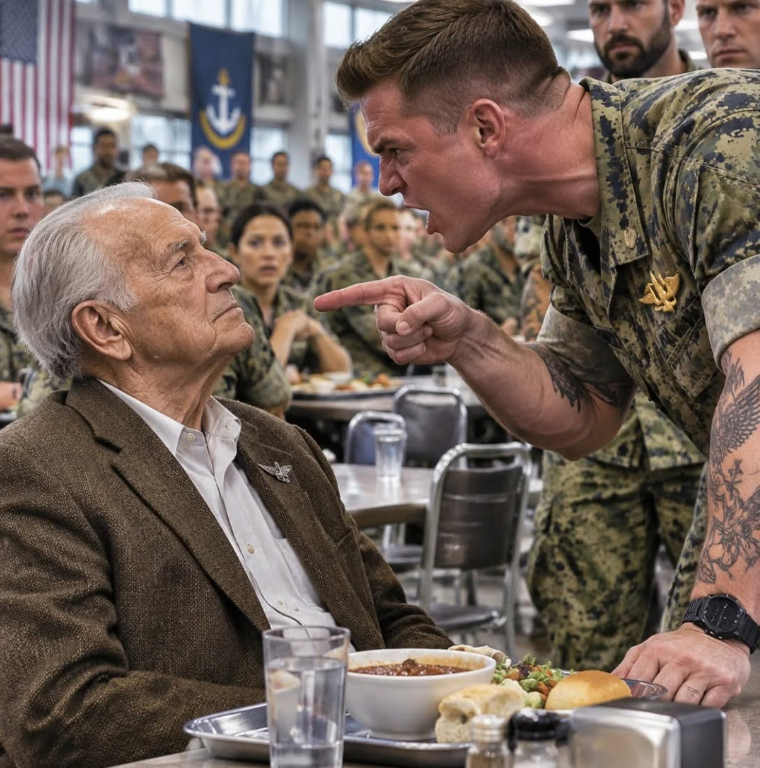
The young SEAL thought it would be funny to ask the elderly veteran about his rank.
He never expected the answer to leave the entire mess hall speechless.
“Hey, Grandpa, what rank did you have back in the Stone Age?”
“Mess cook, third class.”
The question came from Petty Officer Miller, a Navy SEAL whose confidence seemed to come as naturally as his physical strength.
His neck was thicker than most men’s thighs.
Two teammates stood beside him, holding trays stacked with the high-protein, high-calorie meals that kept elite operators in fighting condition.
Together, they formed an intimidating triangle around a small table occupied by a single elderly man.
George Stanton was eighty-seven years old.
He didn’t lift his eyes from his chili.
Instead, he raised another spoonful to his mouth with a surprisingly steady hand, despite the wrinkles and age spots covering his skin.
He wore a plain tweed jacket over a white shirt, an outfit that seemed almost out of place among the digital camouflage and navy-blue uniforms filling the dining hall.
He ate slowly, without hurry, staring toward some distant point beyond the opposite wall of the busy dining facility at Naval Amphibious Base Coronado.
Miller glanced at his teammates with a grin.
Both men chuckled at his joke.
“I’m talking to you, old man.”
Miller raised his voice.
“This is a military installation. You have a pass to be here? Or did you wander over from the retirement home looking for a free meal?”
Something began to change inside the mess hall.
The steady noise of a hundred conversations gradually faded.
As the voices died down, the clinking of silverware against plates became easier to hear.
More and more people turned their heads.
This wasn’t simply a loud young sailor making a joke.
Miller was putting on a show, and the elderly man sitting alone had become his unwilling target.
George finished the spoonful of chili.
He carefully set his spoon beside the bowl, making almost no sound as the metal touched his plastic tray.
Every movement was controlled and deliberate.
Nothing was wasted.
He still hadn’t looked directly at the SEAL standing over him.
That quiet refusal to acknowledge Miller only seemed to aggravate the younger man.
Miller bent forward and planted his heavily tattooed forearms on the table, deliberately invading George’s personal space.
The table, firmly bolted to the floor, didn’t move.
“Look at me when I’m speaking to you.”
The playful mockery had disappeared from Miller’s voice.
Now his words came out as a low, threatening growl.
“We have standards around here. We don’t just let random civilians walk in and occupy a table.”
He leaned closer.
“So I’m asking you one more time. Who are you, and what the hell are you doing on my base?”
The words my base seemed to linger in the air.
Several young sailors sitting nearby shifted uneasily.
They knew Miller.
They knew his reputation.
As an operator, he was exceptional, a highly trained warrior capable of meeting the demanding standards of the SEAL teams.
But Miller wore his Trident as though it were a royal crown.
Anyone who didn’t belong to his elite community was often treated with a level of casual contempt that bordered on outright hostility.
George finally turned his head.
His pale blue eyes were watery with age, carrying an unmistakable sense of exhaustion.
Yet beneath that tired appearance lay something difficult to describe.
A remarkable stillness.
A depth that seemed to go far beyond the old man’s fragile appearance.
His expression was like the surface of a frozen lake, perfectly calm while concealing enormous pressure beneath the ice.
George studied Miller’s face.
Then his gaze moved to the gold SEAL Trident pinned to the younger man’s uniform.
Finally, he looked back into Miller’s eyes.
He didn’t say a word.
“What? Are you deaf?”
One of Miller’s teammates leaned forward from behind him.
“He asked you a question.”
Miller straightened.
“Let me see your ID.”
He made an impatient gesture with his hand.
“Now.”
Everyone close enough to hear understood that Miller had crossed a line.
A petty officer had no authority to demand identification from a visitor simply because the man was eating in a common dining area.
That responsibility belonged to the base security personnel and the masters-at-arms.
But nobody seemed willing to challenge a Navy SEAL in front of an entire mess hall.
The social consequences could be considerable.
It was far easier to look away, pretend nothing unusual was happening, and suddenly become fascinated by the green beans sitting on your plate.
George Stanton didn’t reach for his wallet.
Instead, he picked up his cup of water.
He took a long, unhurried sip.
By now, the area surrounding his table had fallen almost completely silent.
The tension seemed to tighten with every passing second.
Miller’s face began turning red.
He had confronted the old man in public, expecting obedience, embarrassment, or at least an argument.
Instead, George responded with an unshakable calm that made Miller’s aggressive performance look increasingly ridiculous.
And in a military environment governed by rank, discipline, and authority, Miller interpreted that indifference as an unacceptable insult.
Worse, the elderly stranger was making him look foolish in front of his fellow sailors.
“That does it!” Miller snapped.
“You and I are taking a walk to see the MA.”
He pointed sharply at the old man.
“Get up. Right now.”
Then Miller’s attention shifted to a small, tarnished pin attached to the lapel of George Stanton’s tweed jacket...