
Chapter 3
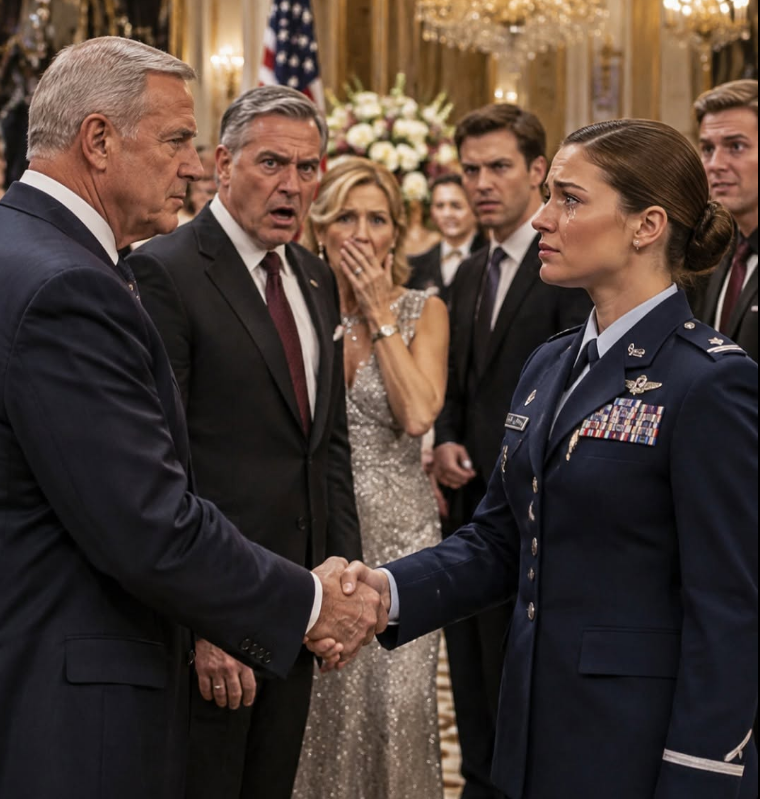
“That’s exactly what my daughter said you’d say.”
Behind him, the ballroom had become a museum of frozen people. Champagne flutes stopped halfway to lips. A waiter stood motionless with a tray of crab cakes. Derek’s mouth hung slightly open.
The President turned, just enough so the room could hear him, though his eyes never really left mine.
“Fourteen months ago,” he said, “a relief aircraft carrying humanitarian workers went down in a place I’m not allowed to name, during weather I’m told no one should have flown in. My daughter, Lily, was on that plane.”
A murmur rippled through the crowd. Everyone knew Lily Whitfield had been injured overseas. The official story was a “transport accident.” Nobody knew the rest.
“A rescue team reached them. What they found was a collapsed building, nine survivors, and very little time.” His voice tightened. “The team’s medical officer stayed inside that building for thirty-one hours. She treated every survivor. When they ran out of blood supplies, she gave her own. When the structure shifted, she shielded my daughter with her body. She carried Lily out on her back the last two hundred yards because the litter had been destroyed.”
He paused.
“I’ve read the after-action report so many times I have it memorized. Every survivor lived. Every single one.”
Nobody in the ballroom breathed.
The President looked past me, toward the spot where Derek stood frozen beside my aunt.
“So when I walked in here,” he said mildly, “and I heard someone describe Major Rowan as only a medic, I confess it took me a moment to compose myself.”
Derek went the color of the tablecloths.
Aunt Vanessa suddenly found her clutch purse fascinating.
Then my father stepped forward. Of course he did. Graham Rowan had never met a camera angle he couldn’t find.
“Mr. President,” he said, his voice rich with emotion, “I can’t tell you what it means to hear you speak about my daughter that way. Claire has always been—”
“Your daughter.” The President turned toward him slowly. “Yes. I suppose she is.”
There was something in his tone I didn’t understand. A coolness.
“Governor-hopeful Rowan,” he continued, “I’ll be honest with you, since honesty seems to be in short supply tonight. Six weeks ago my staff contacted your campaign. We asked whether Major Rowan might attend one of your events, so I could finally thank her in person, since she kept politely refusing to come to me.”