
Chapter 18
When she stepped down, Eleanor was waiting at the end of the aisle. She hugged her daughter for a long time without saying a word.
The jury deliberated for six hours.
Guilty on all counts: two counts of first-degree murder, wire fraud, embezzlement, bribery, and witness tampering.
At sentencing, the judge looked down at Grant over her reading glasses. “You took two lives for money,” she said. “You stole the retirement of thousands of working families. And when your crimes were nearly discovered, you tried to destroy a grieving widow and her unborn child to cover them up. This court finds no mitigating circumstance whatsoever.”
Life in prison, without the possibility of parole.
Grant didn’t look at any of us when they took him away. I’d thought I would feel triumphant. Instead, I felt only a quiet, heavy peace, as if I could finally set down something I had been carrying for a very long time.
Dr. Pruitt received four years. Walter Hollis, who had loosened the brake fitting under threat and payment but had cooperated fully, was sentenced to eight. At his sentencing, he turned to Eleanor and apologized, his voice breaking. She didn’t say she forgave him. But she didn’t look away, either.
The Inspector General’s investigation cleared me completely. The report noted that “General Whitmore’s conduct reflected the highest standards of integrity under extraordinary personal circumstances.” General Ames called me himself.
“Your command is waiting,” he said. “Whenever you’re ready.”
I thanked him. Then I asked for six more months.
He laughed. “Take a year, Sarah. The Army will survive.”
The Richard and David Whitmore Foundation repaid every pension that had been stolen. I insisted on doing it in person, as many as I could. I sat at kitchen tables in Oakland and Long Beach and Stockton, drinking terrible coffee and listening to retired welders and crane operators tell me how close they had come to losing everything. One woman, a widow named Rosa who’d worked for the company for thirty-one years, held James on her lap and told me David had once given her his own coat in a rainstorm.
“Your husband was a good man,” she said.
“He was,” I said. “He still is, in a way. That’s what this is.”
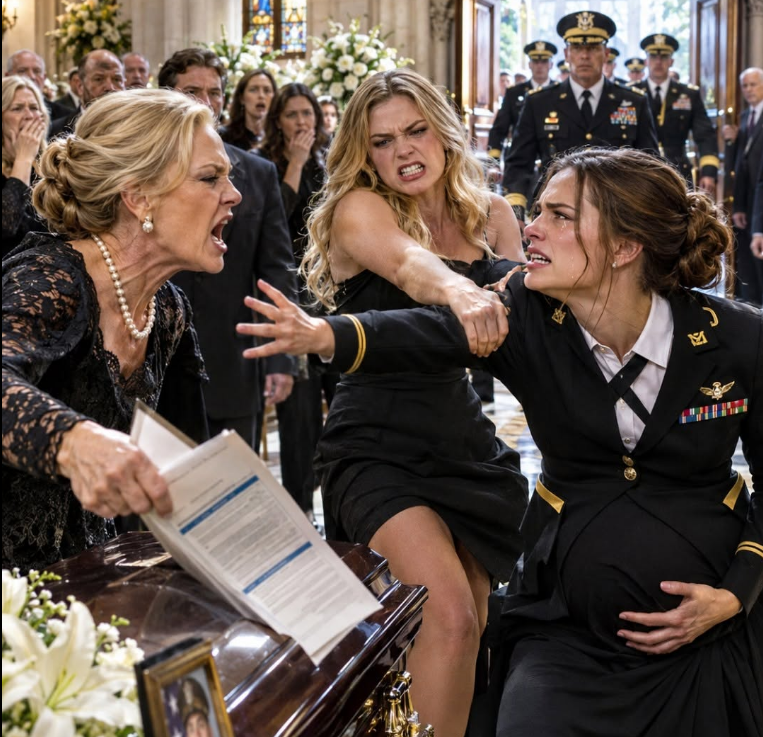
And then, on a bright morning in June, we gathered again in the same cathedral.
The white lilies were back, but this time there were roses too, and sunlight poured through the stained glass in a hundred colors. It wasn’t a funeral. It was James’s baptism, delayed until the trial was over because I wanted him to begin his life in a world where justice had been done.