
Chapter 17
“I visited Vivian last week,” Eleanor said quietly.
I turned toward her. “How was she?”
“Angry. Then quiet. Then she asked if I still remember the thunderstorm song.” Eleanor smiled faintly. “I sang it to her through the glass. The guard thought I’d lost my mind.”
“Maybe you’ll get your sister back someday.”
“Maybe.” She reached for my hand. “But I already got my granddaughter.”
Three weeks earlier, at her insistence and with my whole heart, we’d signed the papers. Adult adoption. Legal. Real. Eleanor Whitmore, eighty-two years old, had become the family my father had promised me in his last letter.
“You know,” I said, “the first night I met you, you told me to pretend I was your granddaughter.”
“I’m a businesswoman,” she said dryly. “I always intended to make it official.”
I laughed, a real laugh, the kind that comes from somewhere deep and healed.
I teach piano now. Three days a week at the community center, two days a week to children at the women’s shelter downtown. My hands are still good. My heart is still stubborn. Some nights, I play my father’s old songs in Eleanor’s library while she listens by the fire with her eyes closed, humming along off-key.
People sometimes ask me how I survived that night in the rain.
I tell them the truth.
I didn’t survive because a rich woman rescued me. I survived because, for the first time in seven years, someone looked at me, a blind woman who couldn’t see my face at all, and still saw who I was. And that reminded me to see myself.
Family isn’t the people who share your last name. It’s the people who share your burden. Self-respect isn’t something anyone can teach you by leaving you in the cold. It’s something you build, one brave choice at a time. And love, real love, never asks you to become smaller.
It holds an umbrella over you and waits until you’re ready to stand.
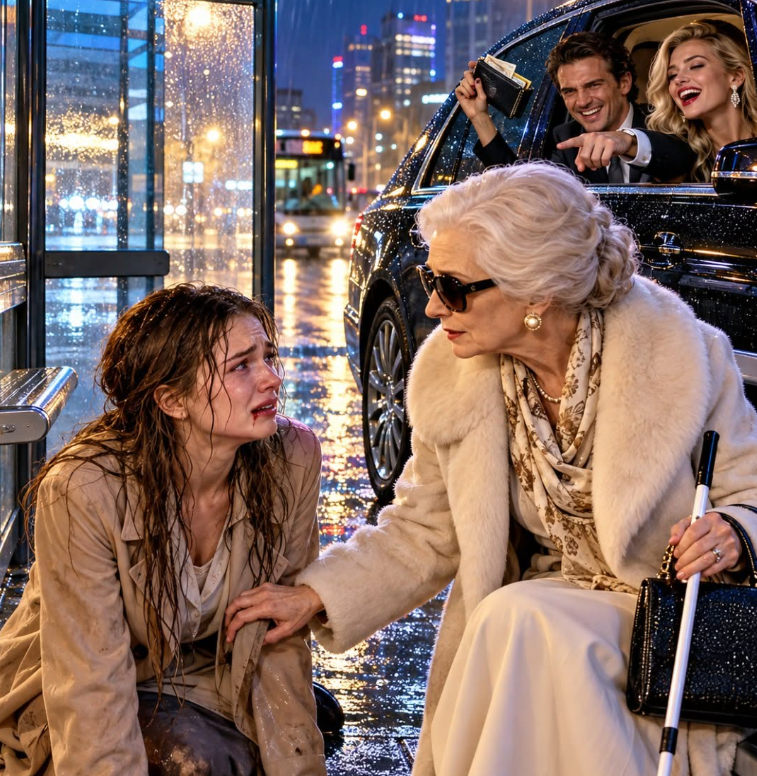
The rain eased. Marcus stepped forward, umbrella open.
“Ready, ladies?”
Eleanor rose, cane in hand, and took my arm.
“Come along, granddaughter,” she said. “Let’s go home.”
THE END