
Chapter 11
And a small, poisonous voice in my head whispered: Maybe they’re right. Maybe you’re not okay. Look at you.
I called Rachel at 2:47 a.m. She answered on the first ring, wide awake.
“I can’t do this,” I said. “What if the judge believes them? I did laugh. I laughed until I couldn’t breathe.”
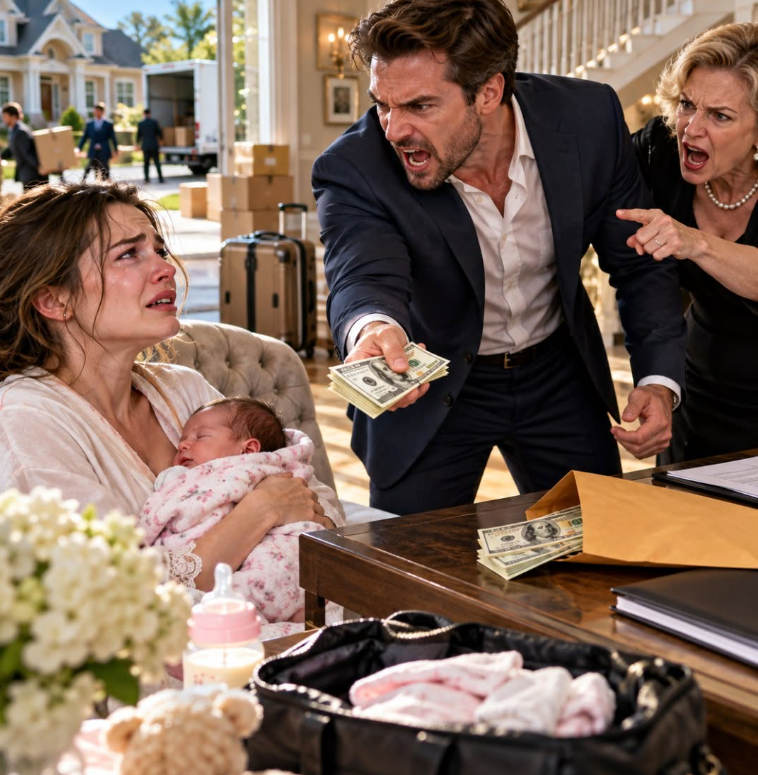
“Nora, listen to me.” Her voice was steady as a hand on my back. “You laughed because the man who abandoned you in labor handed you two hundred dollars for a house he didn’t own. That’s not psychosis. That’s the sanest reaction anyone has ever had to anything.”
“Then why does it feel like they’re winning?”
“Because it’s two in the morning and you’ve slept six hours in nine days. That’s what they’re counting on. Now feed your baby, try to sleep, and I’ll be there at nine.”
At nine, Rachel came with coffee and a plan.
“First, this isn’t about Harper,” she said, tapping the petition. “Read the relief section.”
I had skimmed it. Now I read it properly. Christopher wasn’t only asking for custody. He was asking for “temporary child support commensurate with Respondent’s substantial liquid assets” and “interim spousal support pending equitable distribution.”
“He wants the money,” I said slowly.
“He wants the money. He can’t get the house, so he’s going after the proceeds. If he gets Harper, he gets leverage, and he gets support payments from a three-million-dollar sale.” Rachel’s mouth was a flat line. “Christopher’s lawyer is Brent Haskell. He’s aggressive, he’s expensive, and he doesn’t usually take clients who can’t pay. Somebody’s paying him.”
“Brenda.”
“That’s my guess. With whose money?”
We both knew the answer. Victor’s seven hundred thousand.
The hearing was set for nine days later. Rachel’s strategy was simple: overwhelm the lie with truth. I saw my OB, who documented my recovery and noted no signs of postpartum psychosis. I saw Harper’s pediatrician, who wrote that she was thriving, gaining weight, and “clearly in attentive, loving care.” And at Rachel’s suggestion, I voluntarily scheduled an evaluation with a perinatal psychologist in Mechanicsburg, a soft-spoken woman named Dr. Imani Ross.
“Why are you here?” Dr. Ross asked at the start of the session.
“Because my husband says I’m crazy.”
“Are you?”
I opened my mouth, closed it, and then, absurdly, I laughed. A small, tired laugh. Dr. Ross smiled.
“That,” she said, “is a very healthy laugh.”