
Chapter 17
“Captain Brooks,” the defense attorney said, “isn’t it possible Colonel Ellison stopped that batch only because she knew she’d been caught?”
Nia looked at him the way she used to look at a forty-dollar discrepancy.
“Sir, if Colonel Ellison had wanted to steal twenty-two million dollars, she had every opportunity for fourteen months. Instead, she stopped it with eleven minutes to spare while she was suspended, humiliated, and had nothing to gain.” She paused. “Forty dollars is how fraud starts. Integrity starts the same way. I’ve watched her practice it for six years.”
Tyler testified next. His hands shook, but his voice didn’t. He described the cigar club, the leather folder, the night he opened it. When the prosecutor asked why he’d gone to the FBI instead of protecting his parents, he took a long breath.
“Because my sister has spent her entire life protecting people she’ll never meet,” he said. “The least I could do was protect her once.”
Then it was my turn.
I wore my uniform. I had been told I was allowed to, pending the outcome. It felt heavier than it ever had.
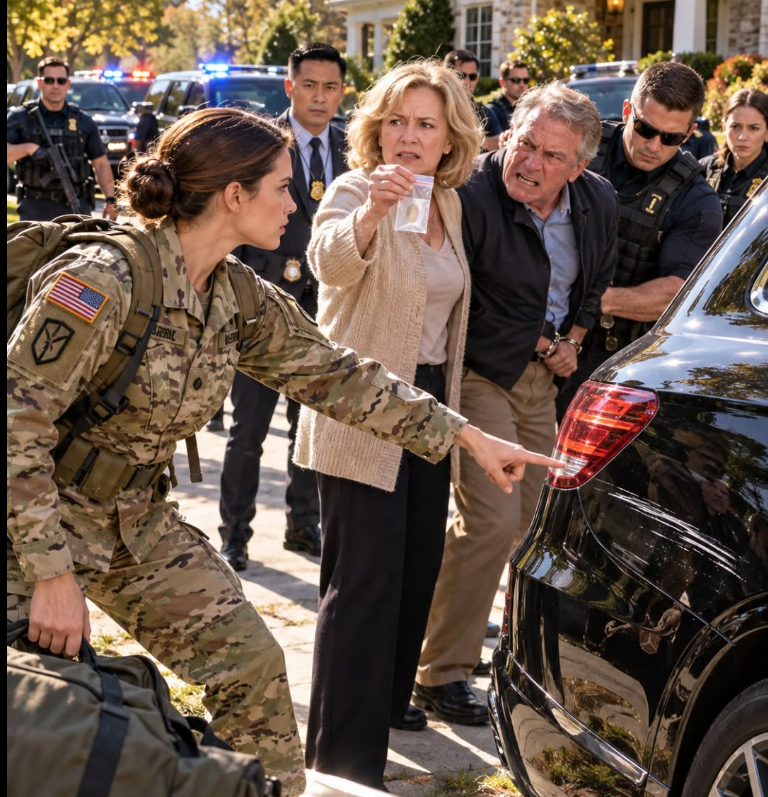
I told them about the driveway. The scratch. The fingerprint membrane in my mother’s fist. The care package with the cookies and socks and the “family memory card.”
“What did you think,” the prosecutor asked gently, “when you pressed your fingers against that card?”
The courtroom was silent.
“I thought my mother finally wanted something to remember me by,” I said. “I kept the card in my vest pocket for two weeks. I thought it meant she missed me.”
Several jurors looked away. One woman in the second row pressed her hand over her mouth.
My mother, seated at the defense table, never looked up.
Colin testified last. Calm, precise, devastating. He laid out every meeting, every invoice, every payment. Pruitt’s role. Elaine’s role. His own.
When he finished, the prosecutor asked one final question. “Major Hayes, why are you testifying today?”
He looked across the courtroom. Not at Elaine. At me.
“Because my sister offered me a way out on that airfield,” he said, “and I was too proud to take it. This is me taking it now.”
The jury deliberated for two days.
On the morning of the verdict, a court officer approached me in the hallway with a folded note.
It was from my mother.
Four words, in the same handwriting as the back of that old photograph: