
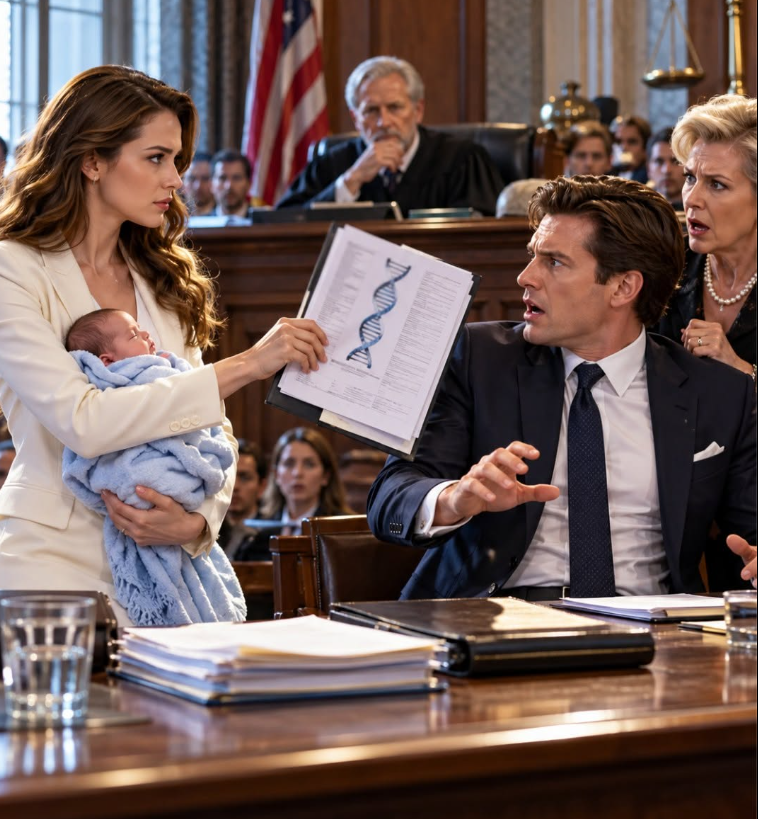
Chapter 12
It was still there when I turned the corner.
I called Margaret from the back seat of my taxi.
“I need two things,” I said. “A sworn affidavit from Lena Brooks before tomorrow morning. And the visitor logs from St. Bartholomew’s intensive care unit for March 2015.”
“The hospital’s records department is being slow,” Margaret warned.
“Then we go around them,” I said. “Dr. Samuel Okoro was my father’s attending physician. He held my hand when the ventilator was switched off. If anyone remembers that week, it’s him.”
There was a pause.
“There’s the Evelyn Hart I trained,” Margaret said softly.
That night, I sat at my kitchen table with Lena’s documents spread around me and Noah asleep in his bassinet. For the first time in years, I didn’t feel like a wife waiting for permission.
I felt like an attorney preparing for war.
PART 6
The hearing three weeks later felt like a different courtroom entirely.
The news had spread. Reporters crowded the hallway. Vale Global’s stock had been sliding for days, and analysts on financial channels were speculating openly about the family’s future.
Celeste arrived in an ivory suit and pearls, walking with the calm dignity of a woman who had never lost anything in her life. She nodded at reporters. She smiled at the bailiff. She did not look at me.
Adrian came in separately. He sat on the far end of the bench, away from his mother, with a new attorney beside him. I noticed Gregory Pike was now seated next to Celeste.
Margaret leaned toward me. “Interesting. Mother and son have separate counsel now.”
Judge Lowell entered, and the room rose.
“We’re here,” she said, settling into her chair, “to resolve whether Section Fourteen of the Hart Capital investment agreement remains enforceable, and whether its conditions have been met. Mr. Pike, you’ve submitted an addendum you say voids the clause. Please proceed.”
Pike stood and presented the document with smooth confidence. He called a handwriting analyst who testified that the signature was “consistent with” Thomas Hart’s known signatures. He called the elderly notary, now retired, who said he “believed” he had notarized the document but admitted he could not recall the specific occasion.
When it was Margaret’s turn, she rose slowly, buttoning her jacket.
“Your Honor, I’d like to call Dr. Samuel Okoro.”
A tall man with gray at his temples walked to the stand. He was now the chief of critical care at St. Bartholomew’s. When he passed me, he gave me a small, gentle nod, the same nod he had given me eleven years ago in a hospital corridor.