
Chapter 6
He leaned toward the camera. His voice dropped, the way it used to when he was about to tell me something that mattered.
“Julian, if you’re watching, I want you to hear this clearly. I don’t believe you built this alone. You were never patient enough to forge a signature that well. Someone taught you. Someone helped you. Someone has been whispering in your ear for a long time that the world owes you something.”
Dad paused, breathing hard. It cost him to talk that long by then.
“I’ll say only this, and the investigators can do the rest. Ask Raymond where he was on February ninth. Ask him who notarized that paper.”
The video ended.
No one moved.
Then every head in the room turned toward the bookshelf where Uncle Raymond had been standing.
He wasn’t there.
Through the study window, I saw his silver sedan backing out of the driveway, too fast, its rear tire crushing the edge of Dad’s flower bed. The roses Dad had planted for Mom the year before she died.
Marcus Hale was already on his phone. “Subject leaving the residence, silver Buick, Ohio plates. Yes. Now.”
Julian stared at the empty space beside the bookshelf. He looked like a boy who had just realized the adult holding his hand had let go in a crowd.
“Uncle Ray?” he said to nobody.
Serena sank into the armchair by the fireplace and covered her face.
I should have felt triumphant. I had been vindicated in front of everyone who mattered. Aunt Carol was already crossing the room toward me with wet eyes and an apology forming on her lips.
But all I could think about was Dad’s voice saying ask him who notarized that paper, and a memory I had pushed away for years. Raymond at our kitchen table when I was a teenager, practicing signatures on a legal pad for fun. Dad’s signature. Mom’s. Mine.
It’s a party trick, he’d said, laughing. Every good businessman should know whose name is on the line.
My phone buzzed in my pocket.
A text from an unknown number.
You should have kept that safe closed. Your father isn’t the only Whitmore who can disappear.
PART 4
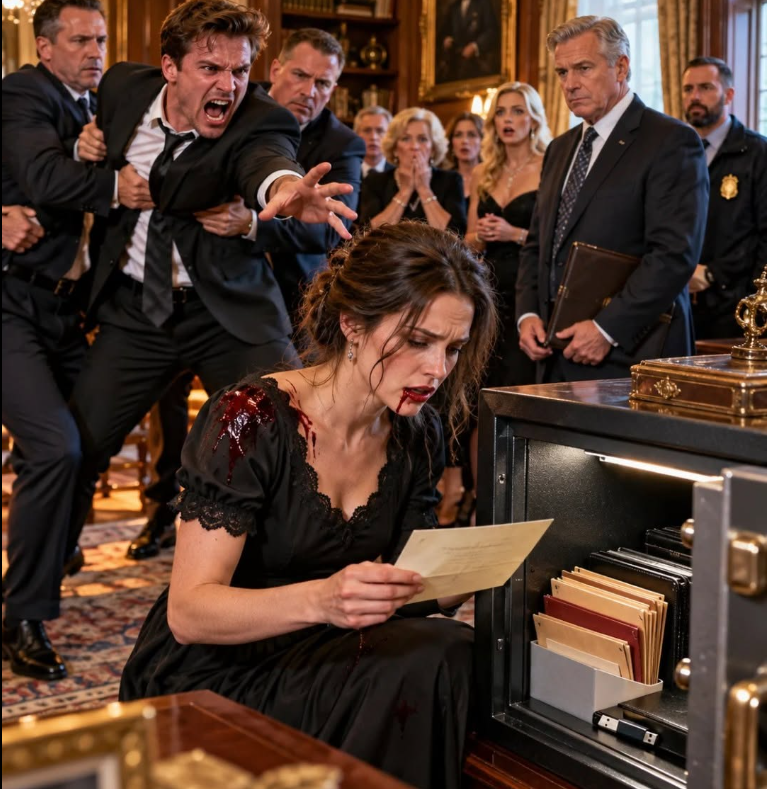
The emergency room at St. Vincent’s smelled the way it had all last week, antiseptic and burnt coffee. I had sworn I would never walk through those doors again. Now I sat on a paper-covered exam table in a funeral dress stiff with dried blood while a physician’s assistant put three stitches in my lip.