
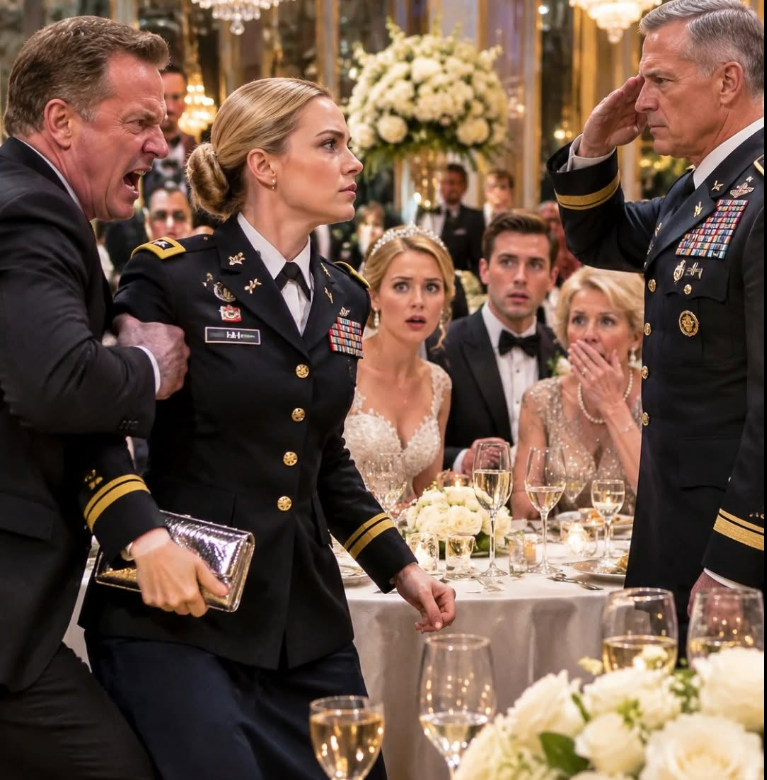
Chapter 10
“Caleb,” he said.
“We’ll get him back, sir,” I said. “Midnight. We have three hours.”
He nodded once. Then he squared his shoulders, and the general returned. “Tell me what you need.”
What I needed, I realized, was sitting downstairs pretending to eat crème brûlée.
I found my father in a small parlor off the main dining room, alone, holding a glass of scotch he hadn’t touched. My mother was gone. The broken glass and wine-soaked tablecloth had been cleared away, but he was still staring at the spot.
He looked up when I walked in. Barefoot. Hair falling loose. Gun-steady eyes.
“Mara,” he started. “Whatever Nathaniel said—”
“Did you photograph my military ID?”
His mouth closed.
“Eighteen months ago,” I said. “While I was deployed. You still have a key to my apartment. Mom gave it to you after I broke my ankle. You went in. You found my ID card. You took pictures. You sent them to Victor Hale.” I kept my voice level. I’d interrogated men who’d planted bombs. I could do this. “Yes or no.”
The scotch glass shook in his hand. He set it down.
“He said it was routine,” Dad said finally. “Background screening. Julianne was being considered for vice president, and Victor said the firm had government clients. He needed to verify family members. That’s all. Just verification.”
“For how much?”
He flinched.
“How much, Dad?”
“He forgave the loan.” Barely audible. “Four hundred thousand dollars.”
I had thought nothing he could say would surprise me anymore. I was wrong. There’s a specific kind of silence that happens inside you when you learn exactly what you’re worth to someone. Mine was four hundred thousand dollars.
“You knew,” I said. “All this time. At dinner tonight, you stood up and told fifty people I had a keyboard job. And you knew.”
“I—”
“Why?”
He didn’t answer. He picked up the scotch again and didn’t drink it.
“Why?”
The parlor door opened behind me.
My mother stood there. She’d changed out of her wine-stained dress into a plain navy cardigan. Her face was blotchy, but her eyes were dry and steady in a way I’d never seen them.
“Tell her, Richard,” she said.
Dad stared at her. “Elaine. Don’t.”
“For thirty-four years, I’ve stared at tablecloths so I wouldn’t have to look at what you were doing.” She stepped inside and closed the door. “I’m done looking at tablecloths.”