
Chapter 19
Rear Admiral Douglas Kemper testified first.
He was smooth. Experienced. He spoke about “the troubling appearance of family influence” and “questions about the nominee’s judgment.” He hinted, carefully, that I had known about the Hayes & Sons problem for years and protected my family. He produced a copy of the original casualty report — with what appeared to be my concurring signature on the final page.
A murmur swept the room.
When it was my turn, I did not raise my voice.
“Senators,” I said, “that signature is not mine. I’d like to submit three items for the record.”
The first was my original email, recovered from Elliot Shaw’s records and verified that morning by Navy cybersecurity — timestamped, unaltered, showing that I had refused to concur and demanded an audit.
The second was Chief Ortiz’s maintenance logs: two separate reports, signed by Tyler Brooks and Ortiz himself, warning that the valves were defective weeks before the casualty.
The third was the memo Ortiz had kept for three years. The one in which Rear Admiral Kemper directed the investigating officer to “close out the Calloway matter as a manufacturing defect without further materials review,” and to “ensure the Hayes vendor relationship remains undisturbed pending FY contracts.”
Kemper had sat on the board of a defense consulting firm for which Walter Kessler had quietly been paying fees through Meridian for six years.
The room went silent.
The committee chairwoman, a senator from Maine with forty years of public service, removed her glasses. “Admiral Kemper,” she said, “would you like to respond?”
Kemper’s lawyer leaned over and whispered in his ear.
“On the advice of counsel,” Kemper said, his voice hollow, “I decline to answer.”
Then my father stood up.
It was out of order. The chairwoman’s gavel was already lifting. But something in his face — or perhaps the cane, or the tremor he no longer tried to hide — made her lower it.
“Madam Chairwoman,” he said. “My name is Leonard Hayes. I own the company you’ve been hearing about. I’d like to say something for the record, if you’ll let me.”
She nodded slowly.
My father turned — not toward the senators, but toward me.
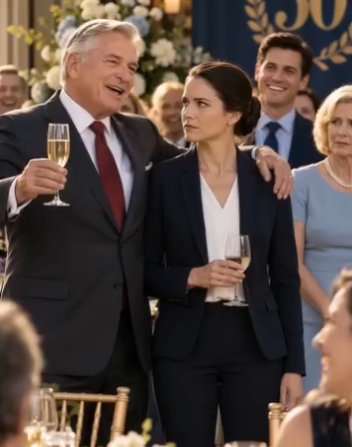
“For twenty-two years,” he said, “I told everybody who would listen that my daughter was pretending. That the Navy would chew her up and spit her out. I said it at my own company’s anniversary party, in front of two hundred people, while she stood there and took it.” His voice broke. He steadied it. “I was wrong. I was wrong about her from the day she enlisted. She’s the most honest person in my family. She’s the only one of us who never sold out a single human being to save herself. If you want to know what kind of officer she is, don’t ask a man like me. Ask Mrs. Brooks.”