
Chapter 21
We have dinner every Thursday. Some nights it’s still hard. Some nights we say things that hurt. But we keep showing up, and I’ve learned that’s what healing actually looks like. Not a single grand apology, but a thousand small Thursdays.
Sophie and Ethan finally went to Maui in February. She sent me a photo from the beach with a caption that said, Wish my sister was here. When she got back, she asked if she could come work at the company. Not in an office. On the job sites, in a hard hat, learning how buildings actually stand up. She’s terrible at it. She’s getting better. We laugh more now than we ever did as children.
As for Hart Pryce Development, it doesn’t exist anymore.
With my fifty-one percent and Cross Harbor’s restructuring of the debt, which Naomi negotiated with Julian still carefully recused, the board voted me in as chief executive in April. My first act was to change the name back. My second was to add one more.
The sign above our office door in New Haven now reads Pryce Reyes Design & Development. Rosa cut the ribbon herself with a pair of enormous ceremonial scissors, and she cried, and so did Harold Benning, and so did half the staff. Our first new project is affordable family housing on the edge of the city, eighty units, every single one with a window facing the morning.
And in June, on a warm Saturday evening, Julian and I finally had the wedding we’d skipped.
We held it at the restored inn in Mystic, where we’d met. There were no four hundred guests. There were forty-two. My mother, in a soft blue dress, walked me halfway down the aisle. Rosa walked me the rest of the way, her arm hooked tightly through mine. Sophie was my maid of honor. Lily Cole caught the bouquet and screamed. Harold gave a toast that made the whole room laugh and then made the whole room cry.
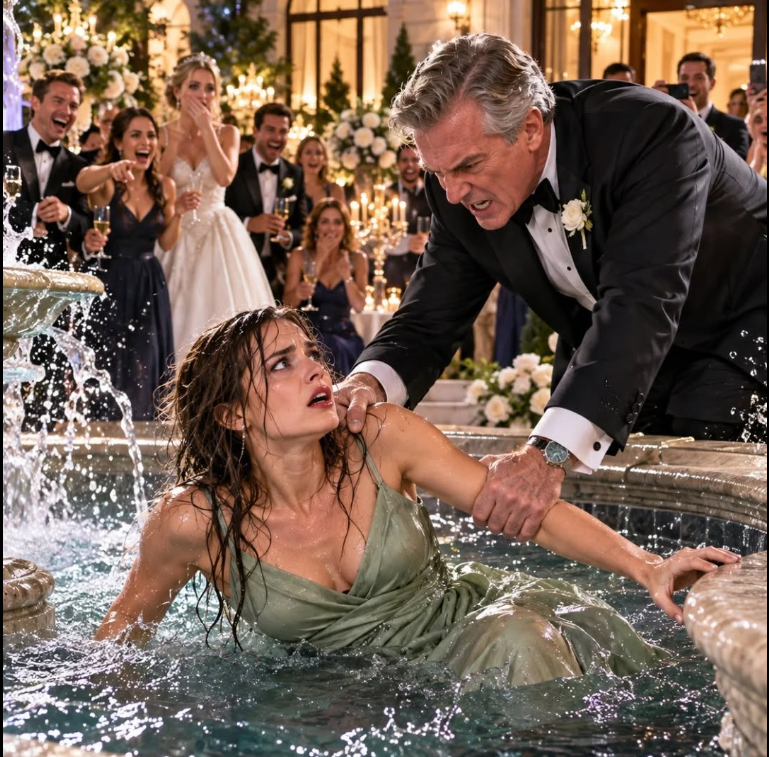
After dinner, as the sun dropped low over the water, Julian led me out to the courtyard. In the center stood a small stone fountain, newly restored, its water catching the last gold light of the day.
I stopped.
“I wasn’t sure,” he said quietly. “If it would bring back bad memories. I can have it turned off.”
I looked at the fountain for a long time. I thought about cold water, and wet silk, and four hundred people clapping. I thought about a girl who’d spent thirty-two years believing she was the punchline in her own family’s story.