
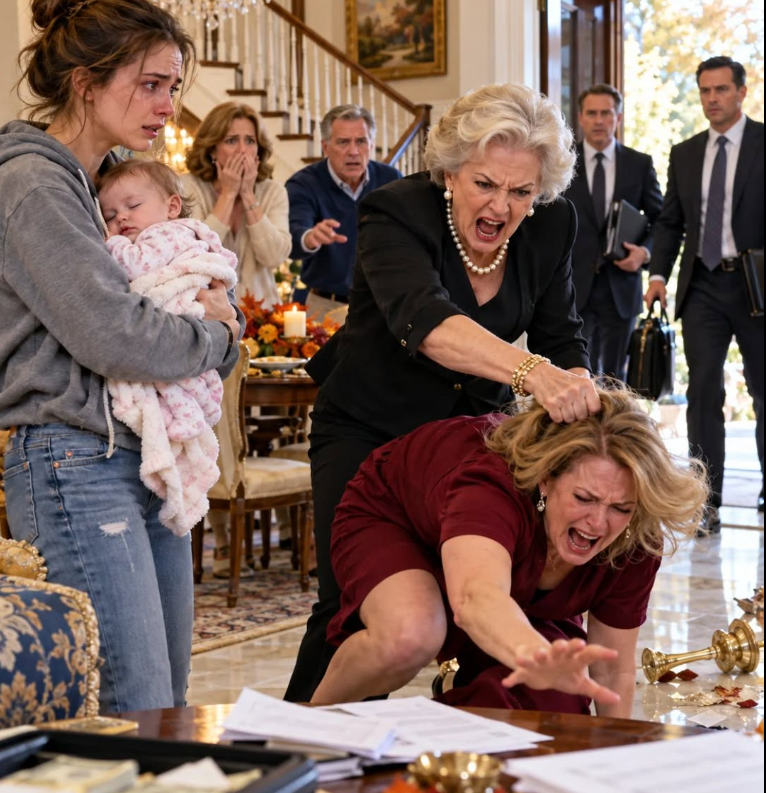
Chapter 6
“And?”
He hesitated.
“Two weeks ago, a petition was filed in Suffolk County Probate Court. It requests that you be declared mentally incapacitated and that a guardian be appointed to control your finances.”
Grandma didn’t move.
“Who filed it?” she asked.
Richard looked at Patricia.
PART 4
For a moment, I thought Grandma might break.
She was eighty-one. She had buried a husband and a son. She had flown across the country to spend a holiday with her family, and she had just learned that her own daughter had asked a court to declare her unfit to run her own life.
But Margaret Whitmore didn’t break.
She folded her hands in her lap and looked at Patricia with an expression so calm it was frightening.
“Tell me your reasoning,” she said. “I’d like to hear how you described me to a judge.”
Patricia’s composure was splintering. “Mother, you’ve been forgetting things. You called me twice in August asking about the same appointment. You misplaced your reading glasses for a week.”
“I’m eighty-one, Patricia. Reading glasses are my nemesis.” Grandma’s voice didn’t rise. “What else?”
“You’ve been confused about money.”
“Have I?”
“You—” Patricia stopped.
And then I understood. I saw it all at once, the way you finally see the shape in one of those optical illusion pictures.
“Tonight,” I said slowly. “This was supposed to be part of it.”
Everyone looked at me.
“She didn’t expect you to ask me about the money in the doorway, Grandma. But she knew it would come up eventually. And when it did, she’d tell everyone you were confused. That you imagined sending it. That it was proof you needed a guardian.”
Clara nodded once. “That would fit the petition’s timeline. A hearing is scheduled for December ninth.”
“She was going to use me,” I whispered. “Me and Lily. As evidence that you’d lost your mind.”
Grandma turned toward me and, for the first time all night, reached for my hand. Her fingers were thin and cool and stronger than I expected.
“Well,” she said, “she’s going to be disappointed.”
Patricia laughed, a high, brittle sound. “You think a judge will believe a woman who couldn’t even keep track of her own granddaughter for two years? You never called her, Mother. You never visited. Not once after Evan died.”
The words landed like a slap.
Grandma’s grip tightened.
“I wrote to her,” she said, looking at me. “Three weeks after the funeral. A long letter. I told her I was sorry I had been cold about Evan at first. I told her I was wrong about him. I asked her to come to Boston with the baby.” Her voice finally wavered. “She never answered. Then Patricia told me you’d said you didn’t want to hear from me. That you blamed me for not accepting him.”