
Chapter 17
I reached across the table and took her hand. It was the first time we had ever touched.
“They’d like that,” I said. “So would I.”
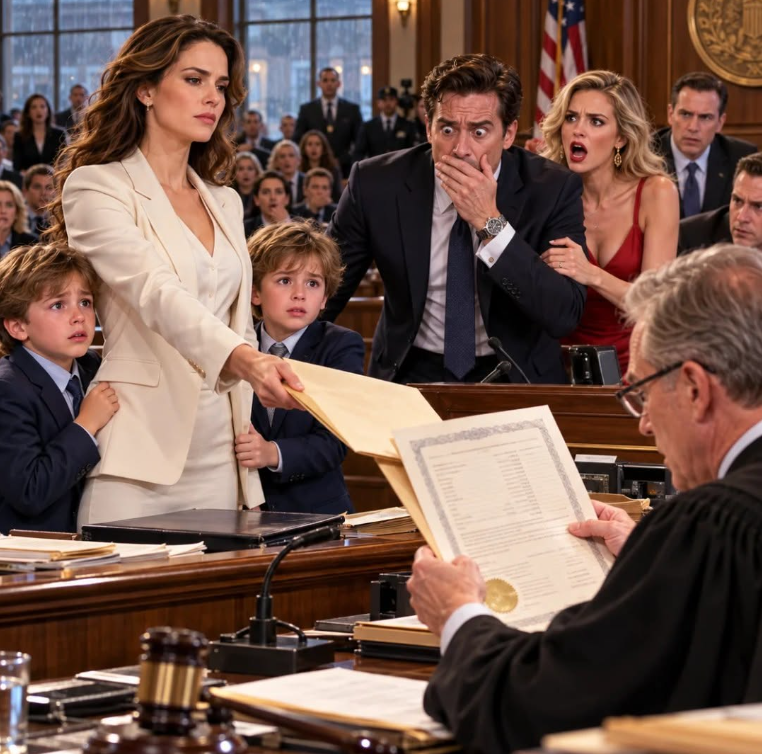
On Thursday morning, it was raining again. Courtroom Four was packed. Adrian appeared by video from detention, in an orange jumpsuit, his face thin and gray.
Judge Calder took his seat and opened a thick file.
“I have reviewed the testimony, the hospital records, the forensic report from the Virginia Department of Forensic Science, the notary records, the report of the guardian ad litem, and a letter from the respondent’s mother,” he said. “My findings are as follows.
“First: Hollis Transit Systems was founded by Claire Lane before the marriage. Under Section Four of the prenuptial agreement, which the respondent’s own counsel drafted, her shares are her separate property. The purported 2019 stock transfer is a forgery. It is void.
“Second: The respondent’s motion regarding Ms. Lane’s mental health is denied. The court notes that seeking treatment during a child’s medical crisis is not evidence of instability. It is evidence of responsibility.
“Third: Primary physical and legal custody of Samuel and Owen is awarded to their mother. The respondent may have supervised visitation, conditioned on completing counseling and the outcome of his criminal proceedings.”
He paused and looked at me over his glasses.
“Ms. Lane, I have been on this bench for twenty-two years. It is rare for someone to walk into this room without a lawyer and walk out with the truth. Your sons are fortunate.”
Russell Crane quietly withdrew from Adrian’s case that afternoon. Four months later, Adrian pleaded guilty to wire fraud and forgery and was sentenced to six years in federal prison, with an order to repay what he took. Paige Ellison, who cooperated fully, received probation and lost her notary commission. She sent me one short letter, apologizing to the boys. I kept it for them, for when they’re older.
Nate entered a gambling recovery program the week after the hearing. He went to every meeting. On the boys’ ninth birthday, he showed up with a cake he’d baked himself, lopsided and covered in blue frosting, and handed me his ninety-day chip.
“I don’t expect you to trust me yet,” he said.
“Then keep showing up,” I said, and hugged him until he laughed.
Six months after Judge Calder’s ruling, on a rainy Thursday morning, I stood in front of the Manassas depot beside a canvas sheet stretched across the new sign.