
Chapter 2
A man named Dobbs conducted the bidding.
One investor wearing a padded vest kept offering more until the price reached $41,000.
Our absolute limit was $42,000.
Nate took a breath.
“Forty-one thousand five hundred!”
The investor looked at him, shook his head, and withdrew.
“Sold!” Dobbs declared.
I handed the clerk a cashier’s check and another $1,500 I’d put aside from my diner tips.
She counted the money twice.
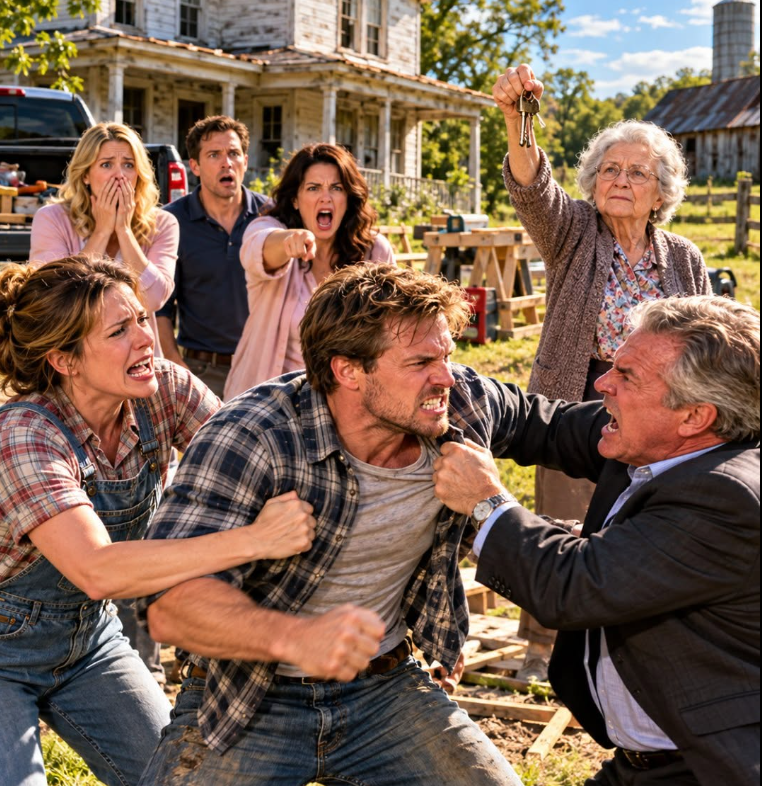
Then she gave us a set of old, scratched keys.
We were homeowners.
But we didn’t announce it to the family.
After finishing his regular workdays, Nate spent his evenings replacing the farmhouse’s electrical wiring.
He worked through the rooms individually, making progress whenever he could.
I spent my free hours scraping decades of wallpaper from the walls.
The skin on my thumbs split from all the peeling and scrubbing.
Still, every repaired room brought us closer to the home we’d dreamed about.
We thought we could keep our purchase private.
Unfortunately, the sale eventually appeared in the newspaper’s legal announcements.
And there was one person who read that section religiously.
Nate’s grandmother, Opal.
She was eighty-eight and never overlooked a single notice.
One afternoon, my telephone rang while I was working at the hospital.
It was Opal.
“Come get me after church this Sunday,” she instructed.
Then she added something unexpected.
“And don’t say a word about it to Ronald.”
I didn’t understand why she wanted the visit kept secret.
But I agreed.
That Sunday, I picked her up after the service.
Then I drove six miles along the country road toward our newly purchased farmhouse...
PART 2
Opal didn’t say much on the drive.
She sat with her black pocketbook on her lap, both hands folded over the clasp, watching the fence posts slide past like she was counting them.
When we turned onto the gravel lane, she said, “Slow down, Lainey.”
Then, a few yards later: “Stop here.”
I stopped beside the old mailbox post. It leaned to one side, gray and split, and the hand-painted letters were nearly gone. You could just make out an M and two L’s.
Opal rolled down her window and touched the wood with two fingers.
“My daddy set that post in 1949,” she said. “I held the level for him. I was eleven.”
I stared at her.
“Your daddy?”
“I was born Opal Miller, honey.” She looked at me over her glasses. “Nobody tells young people anything anymore. And young people don’t ask.”