
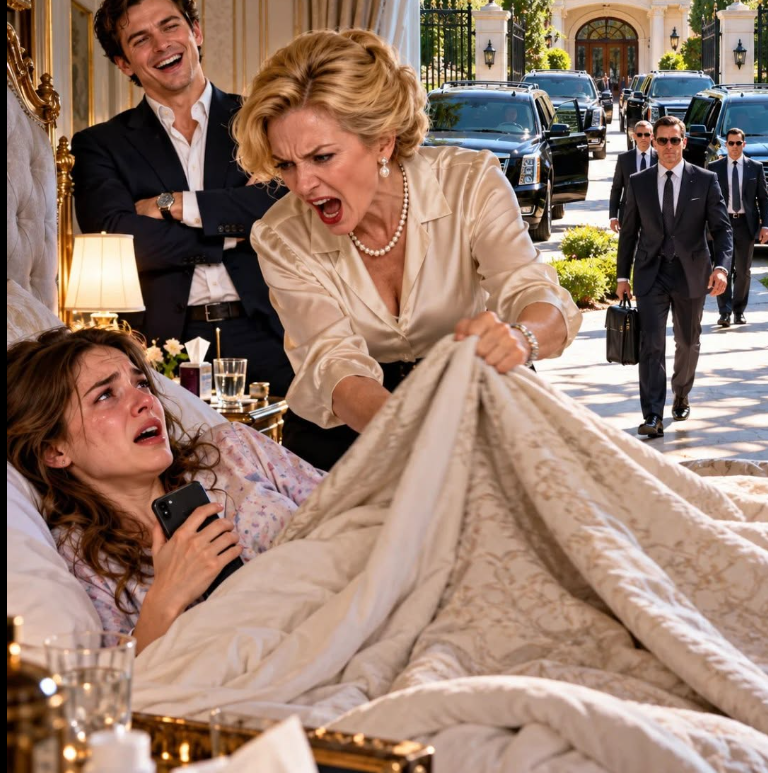
Chapter 6
Lily’s eyes filled. “I didn’t know, Claire. I swear I didn’t know how bad it was.”
“I know,” I said, squeezing her hand. “You were at school.”
My phone buzzed on the tray table. Grace Okafor.
“Claire,” she said, without greeting, “two things. First—the handwriting analyst confirmed it. Every signature on those loan documents is a forgery. Very skilled, but a forgery.”
I let out a breath I hadn’t known I was holding. “And second?”
Grace hesitated. Grace never hesitated.
“While Marcus was going through the Whitmore accounts, he found a life insurance policy. On you. Five million dollars. Beneficiary: Daniel Whitmore.” She paused. “It was taken out ninety-one days ago.”
The same week I’d found that bank letter.
The same week Daniel started telling everyone I “always exaggerated” when I was sick.
PART 4
I didn’t sleep that night.
Every time I closed my eyes, I heard Daniel’s laughter. Not the cruel edge of it—I’d grown used to that—but the ease. As if he’d already rehearsed a future where I didn’t wake up, and found it perfectly pleasant.
Stop being dramatic, Claire.
Not a single doctor called. Not a single cup of tea. Three days of a fever climbing toward the line between sick and gone, and a policy worth five million dollars waiting quietly in a file cabinet.
At six in the morning, Dr. Patel found me sitting up, staring at the wall.
“Your oxygen’s at ninety-six,” she said gently. “Your body’s winning. Let it.”
“Do you think they wanted me to die?” I asked.
She was quiet for a long moment. “I think,” she said carefully, “that people who keep a sick woman away from medical care while holding a policy on her life should have to answer that question under oath.”
They discharged me three days later on the condition that I didn’t go back to the Whitmore estate. Thomas had already arranged a suite at a quiet hotel downtown with a security guard outside the door.
But first, we went to the bank.
The brass key fit box number 1147 at Lakeview Savings & Trust—a small, old-fashioned bank where Harold Whitmore had kept an account for forty years. The branch manager, an elderly man named Mr. Abernathy, studied my ID and then Harold’s notarized authorization, which named me—not Margaret, not Daniel—as the sole person permitted to open it after his death.
“He came in himself to set this up,” Mr. Abernathy said softly. “About two weeks before he passed. He seemed… worried.”