
Chapter 4
“Colonel,” the general said, “at oh-seven-hundred this morning, my office received a phone call from your husband.”
He turned his laptop around to face me.
“And a video.”
PART 3
The video began in my bathroom.
Linda was nowhere in the frame. There were no clippers in her hands, no hair on my pillow, no voice saying I fixed your priorities. Whoever had edited it had cut every second that showed what she had done.
What remained was me.
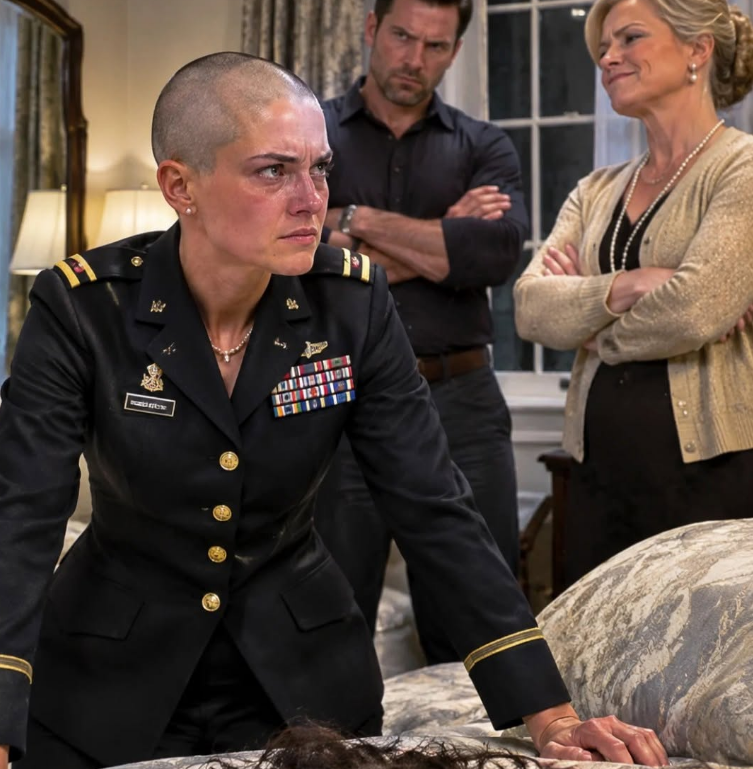
A woman with half her hair hacked away, staring silently at herself in the mirror. A woman picking up the clippers and shaving her own head with eerie, mechanical calm.
Then the woman walked into the bedroom and smiled.
“You were right. Tomorrow, I’m going to devote myself completely to this family.”
Out of context, it sounded like something said by a person who had stopped being herself.
The video cut to a grainy clip of me at the kitchen table at 3 a.m., typing on my laptop, face lit blue by the screen.
Then a final frame. White text on black.
My wife has been unstable for months. Tonight she shaved her head and spent the night draining our family accounts. I am terrified for her and for our family. Please help her before something happens.
The general closed the laptop.
“This is Lieutenant Colonel Simone Avery,” he said, nodding toward the corner. “Staff Judge Advocate’s office. I’d like you to tell us what happened, Colonel. All of it.”
So I did.
I told them about the clippers. About the pain that woke me. About Ryan saying hair grows back. About the unplugged camera and the petition filed nine days before anyone touched my hair. I told it the way I had been trained to brief: facts, sequence, sources.
When I finished, nobody spoke for a long moment.
Avery set down her pen. “Do you have proof your mother-in-law did the cutting?”
“My hair was on my pillow. The clippers were in her hand when I woke up.”
“Did anyone else see it?”
“My husband.”
Avery didn’t need to say what that meant.
General Whitaker came around the desk and sat on its edge. For a two-star general, he had always struck me as unusually human.
“Rachel,” he said, “I’ve known you since you were a captain in Kandahar. I watched you keep a team alive through things I still don’t talk about. I believe you.”