
Chapter 20
“She’s real,” I said. “She’s just got a better parking spot.”
He laughed. Really laughed, for the first time since Thanksgiving.
“Dinner,” he said. “Friday. Somewhere with vending machines, for old times’ sake.”
We went to a diner instead. We’ve been going every Friday since.
My mother and I didn’t fix things in one conversation. We went to a family therapist once a week for most of the year, sometimes with Vanessa, sometimes with Dad. Mom learned to say, “I was wrong.” I learned to say, “That hurt me,” and stay in the room instead of disappearing. Some sessions ended in tears. Some ended in silence. A few, eventually, ended in laughter.
Dad started working part-time at a community hardware co-op. He came alive again behind a counter, recommending the right drill bit to a teenager with a school project. On my birthday, he gave me a small wooden frame he’d built himself, sanded smooth and stained the color of honey.
Inside it was the fifty-dollar bill. Still folded once. Below it, on a small brass plate, he had engraved six words:
The day I learned my daughter’s worth.
It hangs in my office now, beside a photograph of the environmental-services team on the day their raises took effect.
The next Thanksgiving, we gathered at Grandma Evelyn’s house.
It was a smaller crowd. A few relatives didn’t come; they’d chosen sides, and they hadn’t chosen ours. That was all right. The people who mattered were there. Aunt Carol came too, and she and my mother spent the morning in the kitchen together, talking quietly in a way I suspect they hadn’t in fifty years.
Rosa came with her husband. Daniel carved the turkey, badly. Vanessa brought her nursing textbooks and quizzed my cousins on the bones of the hand. Harold Briggs and his wife sent a tin of peanut brittle.
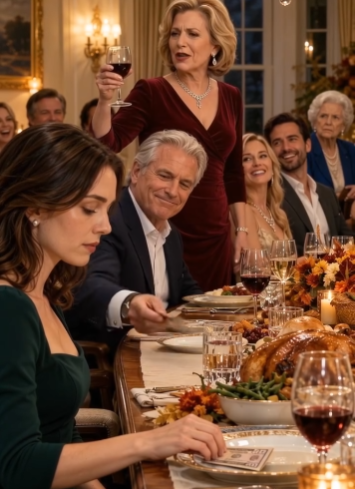
When everyone was seated, my mother stood and lifted her glass.
The room went quiet. I braced myself out of old habit.
“Last year,” Mom said, her voice trembling, “I stood at a table like this one and said something about my daughter that I will regret for the rest of my life.” She turned to me. “So I’d like to say it correctly this time.”
She took a breath.
“One daughter is studying to care for the sick,” she said, and smiled at Vanessa, who wiped her eyes. “And the other one cleaned toilets so that nobody else would ever have to be invisible.”