
Chapter 2
It was Mr. Okafor, our old neighbor from Magnolia Street. He was eighty-one now, and he still called me "Little Sergeant," which he had been calling me since I was seven years old and organized the neighborhood kids into a very serious, very official lemonade operation.
"Riley," he said, "I don't want to stick my nose where it doesn't belong."
"You never have, Mr. Okafor."
"Well, I'm about to." He took a breath. "There's a new family moving into your daddy's house. Nice people. Young couple with a baby. They asked me if the previous owner left because of health reasons, and I didn't know what to tell them. Is your mama all right?"
I was sitting in my truck in a grocery store parking lot.
I don't remember how long I sat there after he hung up.
I remember checking the county website on my phone, and I remember my thumb hovering over the screen, and I remember seeing the sale date, and the price, and the buyer's name, which was not my mother's and not mine.
And I remember thinking about my father.
Dad had been a welder. He had big, scarred hands and a laugh you could hear from two houses away. When I was a kid, he used to take me out to a lake about forty minutes from town, the same lake I was now standing beside, and we would sit on a borrowed dock for hours, catching almost nothing.
"It's not about the fish, kiddo," he told me once. "It's about learning how to sit still long enough to hear yourself think."
He died when I was fifteen.
Before the funeral, he had made sure the house was paid off. He told my mother, "Whatever happens, Val, you'll always have a roof. Nobody can take that from you."
Nobody took it from her.
She gave it away.
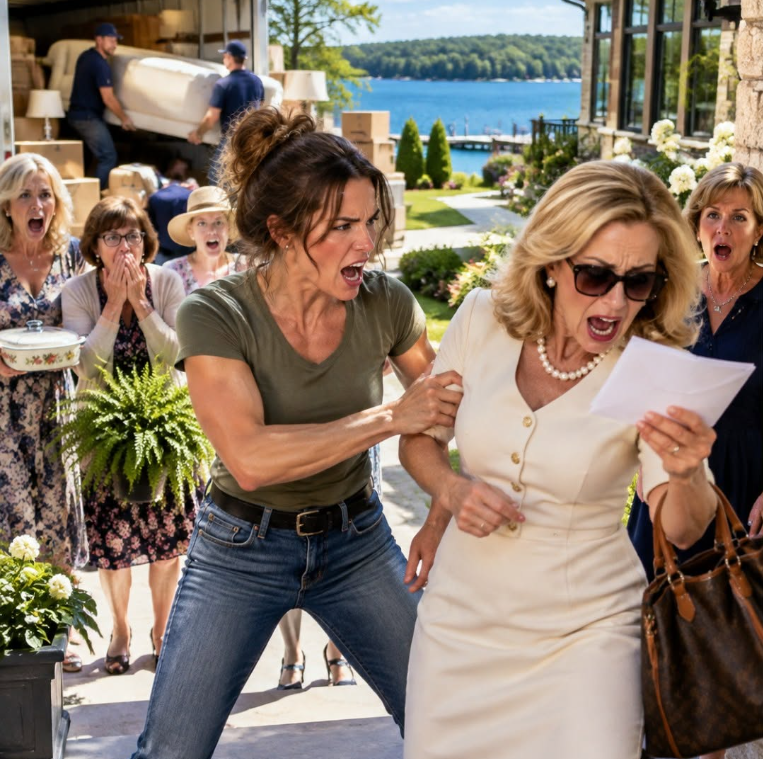
"What is that?" asked the woman holding the casserole.
Her name, I would learn later, was Patricia. She had the kind of tight, careful perm that suggested she had been getting the same haircut since 1994, and she was leaning forward slightly, trying to see over my mother's shoulder.
My mother folded the papers against her chest.
"It's private," she snapped.
"Is it about the house?" Patricia asked.
"It's nothing."
I could have stayed quiet.
For most of my life, that is exactly what I would have done. I would have let my mother fold up the truth and press it against her chest and walk away with it, and I would have carried the weight of everything she didn't want people to see.