
Chapter 16
She left without another word.
Afterward, in the clubhouse parking lot, neighbors hugged me. Someone promised a casserole. Gloria squeezed my hand.
Harold was the last one out. He was looking at his phone, frowning.
“What is it?” I asked.
“I set up an alert on the county recorder’s website for your parcel.” He turned the screen toward me. “Maya, a lien was recorded against your house at 4:52 this afternoon. Before the hearing even started.”
I read the name of the filer.
It wasn’t the association. It was Larkspur Holdings, LLC.
PART 10
The lien turned out to be the mistake that ended everything.
Harold explained it to us the next morning over coffee at Ruth’s kitchen table, while Sam napped in his carrier and Lucy and Owen kicked on a play mat.
“An LLC can’t record an association lien. It’s not the association. And it can’t record a lien for a debt you never owed it. What Vicki and Doug did yesterday was file a fraudulent document against real property. In this state, that’s a felony.”
They had filed it in a panic, hoping to cloud the title before the board could vote. Instead, they had put their names on a public record.
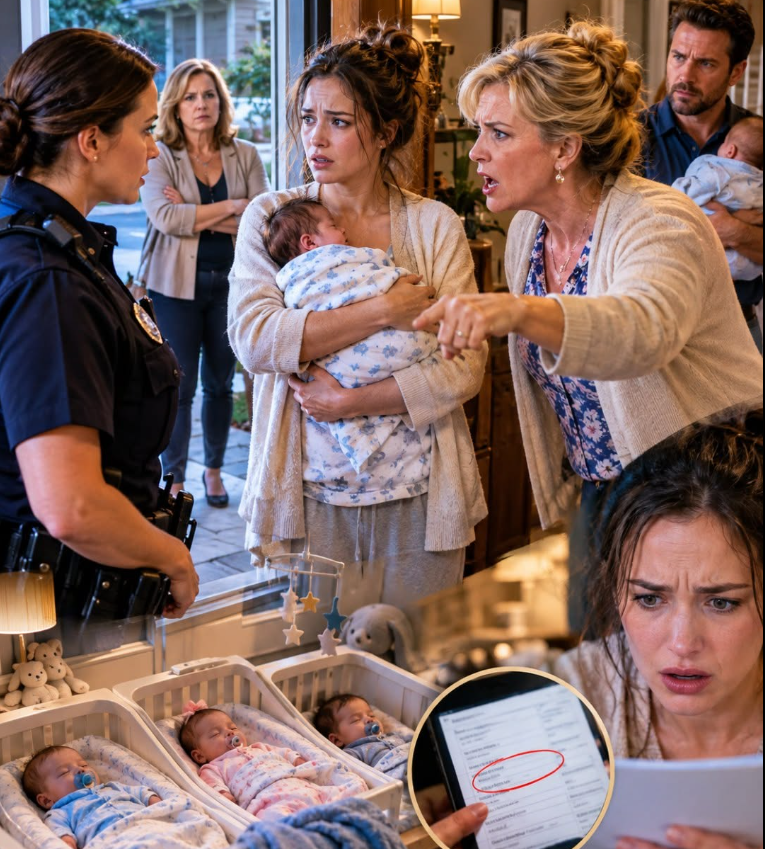
Within a week, Harold filed to have the lien struck and sent a full evidence packet to the state real estate commission and the district attorney’s office. Officer Michelle Lee personally took my statement about the false 911 call. When I thanked her, she shook her head.
“I wrote down what I saw that night,” she said. “Three fed, sleeping babies and two tired parents. Sometimes the report you write accurately ends up being the most important one.”
Things moved quickly after that.
The court voided the lien in under a month. The real estate commission suspended Vicki’s broker’s license pending a full hearing, and later revoked it. Doug Whitfield surrendered his license rather than fight the charges once the text messages showed he had known far more than he’d claimed. Larkspur Holdings, LLC was dissolved. Both of them were charged with filing a fraudulent lien. Vicki accepted a plea agreement that included restitution, probation, community service, and a permanent order prohibiting her from making any further reports regarding our household without cause.
The note for the forty-one thousand dollars was declared void. A judge called it “an instrument procured through coercion and used in furtherance of a fraudulent scheme.” Brendan insisted on paying it back anyway, a little each month, through the court, not to her. “I don’t want to owe her anything,” he said. “Not even a reason.”