
Chapter 16
I sat with that for a long time.
“I don’t think I did,” I said finally. “But thank you for telling me.”
She squeezed my hand once before she left. Her fingers were cold.
The final confrontation came three days later, at a place none of us expected.
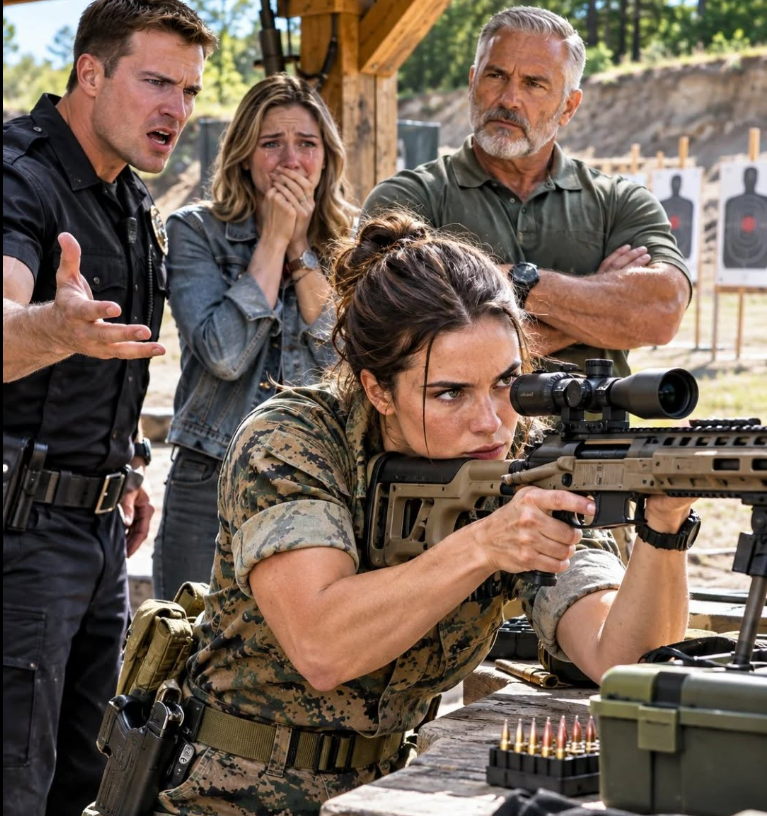
Castellin’s range was hosting its annual Veterans Day community open house—a free event with safety classes, a barbecue, and a new program Castellin had asked me to lead: an introductory course for women veterans who wanted to reconnect with the parts of their training that had once made them feel strong.
Twenty-three women had signed up. Some hadn’t held a firearm since leaving the service. One, a former Army mechanic named Denise, told me she hadn’t left her house for anything but groceries in eighteen months.
I was halfway through my safety briefing when the lobby doors swung open.
Brett walked in.
He was out of uniform—administrative leave meant no badge, no service weapon. He looked hollowed out, unshaven, eyes too bright. Behind him trailed two of his old academy friends, looking uncomfortable.
“There she is,” Brett said loudly. “The famous Hollow Point.”
The room went silent. Twenty-three women turned around.
Castellin started forward. I raised a hand, and he stopped.
“Brett,” I said evenly. “This is a class. You can wait outside.”
“No. I think everybody here deserves to know who’s teaching them.” He spread his arms. “You want to prove you’re real? Let’s go. Right now. Lane one. Ten rounds. You and me. Winner tells the truth.”
My heart was pounding, but not from fear. From sorrow.
Because I finally understood. He wasn’t challenging me. He was challenging his father. And no matter what score he shot, he would still lose.
“No,” I said.
“Afraid?”
“No. I’m just done competing with you, Brett. I never wanted to in the first place.” I took a step toward him. “I don’t need to beat you. I never did. You’re not the person I was ever trying to prove anything to.”
His face crumpled for half a second—then hardened again. “You ruined my life.”
“No,” said a voice behind him. “You did that yourself.”
Lieutenant Teresa Vance stood in the doorway, flanked by two uniformed sergeants. She held a folded document in one hand.
“Officer Holloway,” she said. “I went by your apartment. Your neighbor said you’d be here.” She held up the paper. “Officer Dorsey gave a full statement yesterday afternoon. Both of you are being referred to the district attorney for falsification of official records. In addition, the department has completed its review of your use of a crisis reporting line to intimidate a witness. You are hereby notified of termination proceedings, effective immediately. I’m going to need your department ID and parking pass.”