
Chapter 13
“I’ve never told you this story,” she said after a while. “Not all of it.”
I wiped my face. “Mama, I’m okay.”
“You’re not, and that’s all right.” She folded her hands in her lap. “Before your daddy got his job in baggage, I cleaned bathrooms in the international terminal for twenty-two years. When I started, in 1979, the cleaning staff was told to use the back service entrance. Not because of safety. Because a manager said travelers didn’t want to see ‘people like us’ in the main concourse.”
I turned to look at her.
“I used that back door for six years,” she said. “Then one day I just walked through the front. In my uniform, with my cart. My manager wrote me up. I did it again the next day. And the day after. I got written up eleven times. Then one day the other ladies started walking through the front too. And the manager stopped writing anybody up because he couldn’t fire us all.”
“Why didn’t you ever tell me?”
“Because I wanted you to grow up thinking the front door was yours.” She took my hand. “It is yours, baby. Don’t you dare let some man in a nice suit convince you otherwise.”
The independent examiner was Dr. Alan Whitfield, a former Navy flight surgeon with a calm voice and a bow tie. He interviewed me for two hours. He asked about my sleep, my family, my divorce, my father’s death, and Gate 14.
“When she reached for your phone,” he asked, “what were you feeling?”
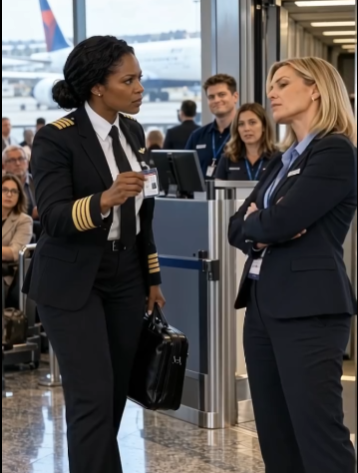
“Humiliated,” I said honestly. “Angry. And very aware that everyone was watching to see if I would become the angry Black woman they’d already decided I was.”
He wrote something down. “And twenty minutes later you flew an Airbus to New York.”
“Yes, sir.”
“How did you manage that?”
“Checklists,” I said. “And my father. He used to say the airplane doesn’t care about your feelings. It only cares whether you did your job.”
Dr. Whitfield smiled for the first time.
Marcus Reed’s statement arrived that afternoon. Renee forwarded it to me. He had written four pages describing every phase of Flight 2187, ending with a line I read twice: Captain Brooks was the calmest person on that airplane. I would fly with her into any weather, on any day, for the rest of my career.
The cockpit voice recordings confirmed it. Every callout correct. Every checklist complete. The flight data showed a textbook approach and one of the smoothest touchdowns recorded on that aircraft all year.