
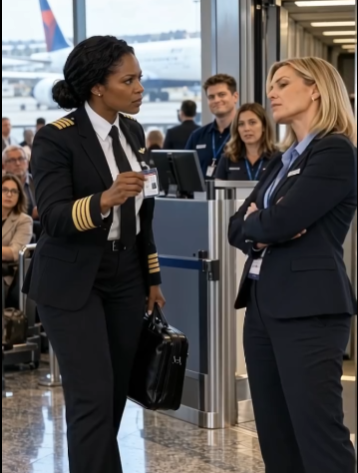
Chapter 4
7:58 a.m.
I looked at my watch. I had arrived at Gate 14 at 8:04.
Someone had reported me late for my own flight six minutes before I even walked up to the podium.
PART 3
There is a rule every pilot learns early: when something feels wrong, you put it aside, finish your checklist, and fly the airplane. Distraction kills. So I took the tablet, photographed the screen with my phone, handed it back to Marcus, and said, “We’ll deal with it on the ground. Let’s get these people to New York.”
Flight 2187 pushed back twenty-two minutes late. I made a short, warm announcement to the passengers, apologizing for the delay without explaining it. Somewhere in row 3, I knew Renee Coleman was listening. Somewhere further back, the old man with the wings pin was listening too.
At cruising altitude, the sky over the Carolinas was clear and soft blue, and for a while the familiar hum of the engines settled me. Marcus handled the radios while I watched the instruments, and my mind drifted somewhere I hadn’t let it go in years.
My father, Raymond Brooks, worked as a baggage handler at that very same Atlanta airport for twenty-six years. When I was seven, he used to take me to the observation deck on his days off. He’d buy me a lemonade and point at every jet that rolled down the runway.
“One of those is gonna be yours someday, Dani,” he’d say.
“Girls can’t fly those, Daddy,” I told him once, because a boy at school had told me so.
My father set down his lemonade and looked at me very seriously. “Baby girl, people are going to tell you what you can’t do your whole life. Your job isn’t to argue with them. Your job is to show up so prepared that their opinion doesn’t matter.”
He died of a heart attack two weeks before I earned my commercial pilot license. I wore his old work badge inside my flight bag for my first solo flight. I still carry it.
Today, someone had looked at my four stripes and decided they didn’t matter at all.
And that was exactly why Margaret had chosen me.
Three weeks earlier, she had called me into her office at headquarters and closed the door. On her desk was a letter, typed and unsigned, from someone inside the Atlanta station. It described flight crews of color, and especially women, being delayed at gates, written up for lateness they didn’t cause, and quietly pushed out of the company. It also described delay codes being changed after the fact so that ground operations always looked perfect and flight crews took the blame.