
Chapter 13
At 6:20, I stood in the courthouse restroom and changed out of my suit and into the navy floral dress.
I looked at myself in the mirror. A woman in a soft summer dress, the kind you’d wear to a garden party. No ribbons. No rank. Nothing.
“I promised,” I told my reflection.
The rehearsal dinner was at the Belle Meade Country Club, all crystal chandeliers and white roses. I was seated exactly where Chloe had asked, at the very last table beside the kitchen door, next to Evan’s ninety-year-old great-aunt and a groomsman’s girlfriend who spent the night on her phone.
Grant gave the first toast, mostly about himself. Dad gave the second, about “the Harlan legacy of excellence.” Chloe glowed in a white silk dress, but every few minutes her eyes flicked to the back table, checking that I was still quiet. Still invisible.
Evan’s mother, Margaret, stopped by my table on her way back from the restroom. She had kind eyes and laugh lines.
“You must be Chloe’s sister,” she said warmly. “She says you work in Kentucky?”
“Fort Campbell, ma’am.”
Something flickered across her face. Recognition, maybe. She squeezed my shoulder and moved on without another word.
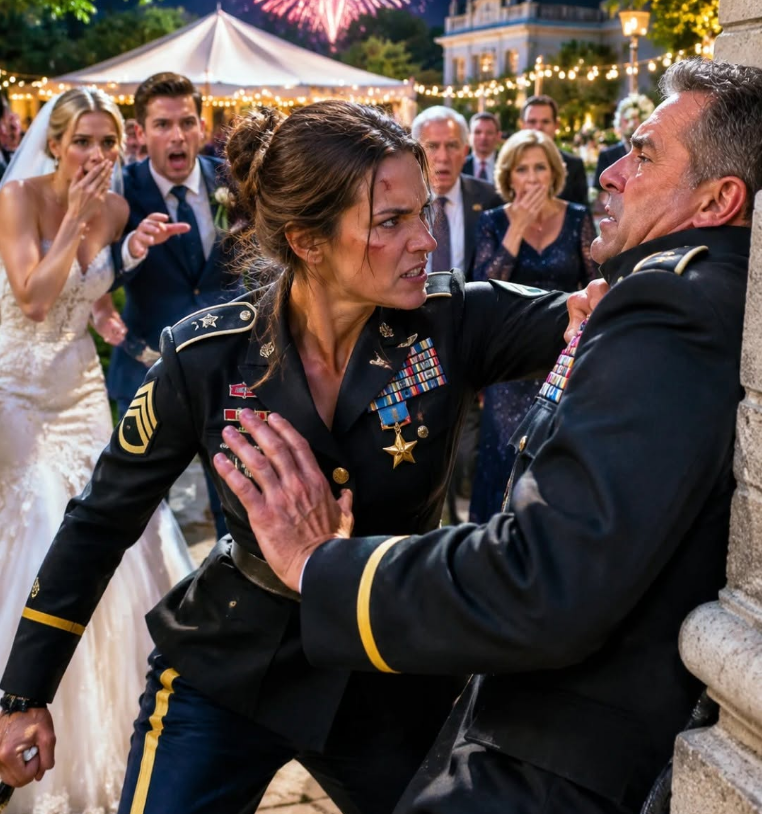
At 7:40, the doors opened and Colonel Thomas Whitmore walked in, late, in a dark suit with a row of miniature medals on his lapel. The room burst into applause. Grant practically leapt from his chair.
“Here he is, everyone! The real war hero!”
The colonel accepted the microphone, smiled at his son, and spoke for a few minutes about Evan: his kindness, his stubbornness, his terrible jokes. People laughed. Chloe wiped happy tears.
Then the colonel’s voice changed.
“People have called me a hero for a long time,” he said. “And I’ve let them, because it was easier than telling the truth. The truth is that twelve years ago, on a road in Kandahar Province, I watched the bravest soldier I have ever known lie pinned under a collapsed wall with her leg shattered, and still disarm a second bomb with her bare hands so that eleven young men could go home to their mothers.”
The room fell completely silent.
“I knelt beside her stretcher and begged her to live. She did. And she never told a single soul. Not even her own family.”
He set the microphone down on the table.
“She’s here tonight.”
He stepped off the small stage and began walking between the tables, past the bridal party, past Dad, past Grant, past the crystal and the roses, straight toward the back of the room.