
Chapter 18
At 2:04 a.m., my phone lit up on the nightstand.
Penn.
“I went to see him,” my brother said without preamble. His voice was strange, flat and shaky at the same time. “Tonight. In his study. I asked him about Kestrel Ridge. About Liora. About the suspension.”
I sat up in bed. “What did he say?”
“A lot.” Penn took a long, unsteady breath. “Sable, I recorded it. All of it. Forty-one minutes.”
PART 9
The Inspector General’s preliminary hearing convened three weeks later in a windowless conference room at the Pentagon, with a long table, pitchers of water nobody drank, and a stenographer who looked like she had seen everything.
It was not a trial. The lead investigator, a calm, silver-haired Air Force colonel named Bernadette Okoro, reminded everyone of that twice. It was a fact-finding proceeding. Statements under oath. Evidence placed in the record.
But everybody in that room knew what it really was.
My father arrived in full uniform. He was still technically on terminal leave, still entitled to wear three stars, and he wore them like armor. Brigadier General Curtis Leland sat beside him, a thin, careful man with rimless glasses. They had a single civilian attorney between them.
My father didn’t look at me when I walked in. He looked at my mother.
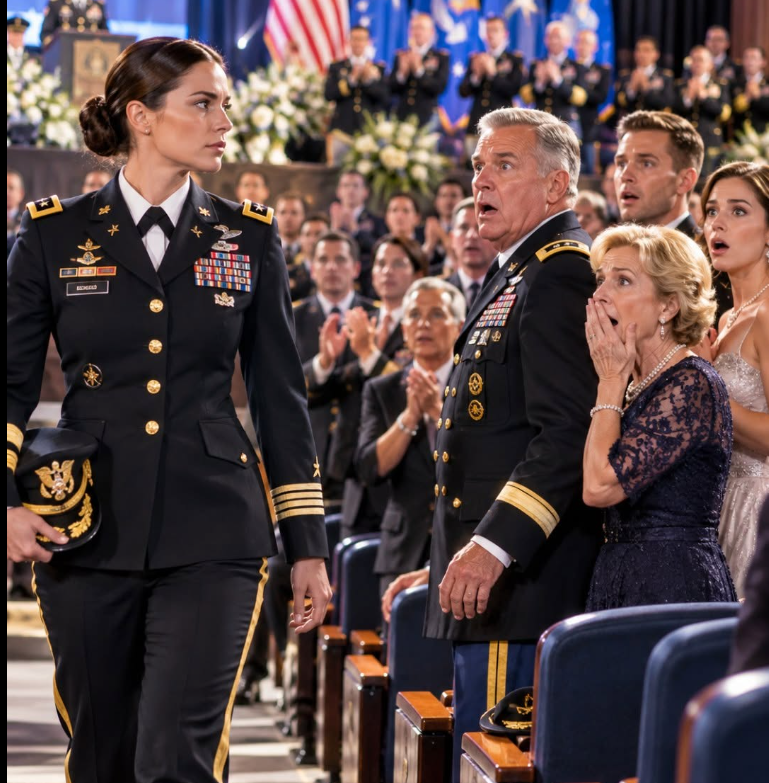
She was sitting in the second row of chairs behind me, beside Liora. She had worn her navy dress, the same one from the ceremony. When my father’s eyes found her, she didn’t look down. That was the first moment I saw him falter.
Leland testified first. He was smooth and patient. The after-action report reflected the best available information at the time. Captain Hensley had indeed taken the western route. No credible prior warning had been documented. He did not recall any intelligence assessment recommending a reroute.
“You don’t recall,” Colonel Okoro repeated.
“It was twenty years ago, Colonel.”
“And the 2021 FOIA redaction bearing your approval code?”
He blinked once. “Routine classification review. I process hundreds.”
My father testified next. He was magnificent, in the way only Harlan Vale could be. He spoke about the fog of war. About junior officers who produced dozens of speculative threat assessments every week. About the tragedy of Kestrel Ridge and how it had haunted him personally.
“My daughter,” he said, and his voice softened beautifully, “has carried a great deal of guilt from that time. I’ve always believed she needed someone to blame. I don’t fault her for that. But I won’t confess to something I didn’t do.”