
Chapter 19
He was so convincing that for one terrible moment, I wondered whether I had imagined my own life.
Then Graham Ashby testified.
He spoke plainly, with his scarred hands folded on the table. He described Captain Hensley standing beside the trucks, saying the lieutenant had good instincts. He described the explosion, the heat, the radio silence. When Leland’s attorney asked whether he might be misremembering a conversation from two decades ago, Graham looked at him for a long moment.
“Sir,” he said, “I remember every word anybody said that morning. I’ve had twenty years of nights to remember it.”
Warren Castellano testified next. He stated, under oath, that he had witnessed my father write Disregard on my assessment, and that he had knowingly signed a false after-action report. He offered to submit his own retirement request immediately. His voice did not break until he said Daniel Hensley’s name.
My father’s face had gone the color of old paper.
Then Naomi Reyes placed my father’s unsent letter into the record. A handwriting expert’s report was attached. Colonel Okoro read the words aloud in her calm, even voice.
Kestrel was my call. The girl was right. I couldn’t push the brief. Leland handled the paper.
Leland’s attorney leaned over and whispered something urgently into his ear. Leland’s hands had begun to shake.
“Mrs. Vale,” Colonel Okoro said gently. “Can you tell us where this letter was found?”
My mother stood up. She walked to the table with steady steps, sat down, and placed her hand on the Bible.
“In my husband’s footlocker,” she said. “Under the lining. I’ve been married to him for forty-one years, and I believe he is a good man who did a terrible thing and then spent twenty years making it worse.” She looked across the room at him. “Harlan, I’m so sorry. But I’m not going to lie for you anymore.”
And then it was Penn’s turn.
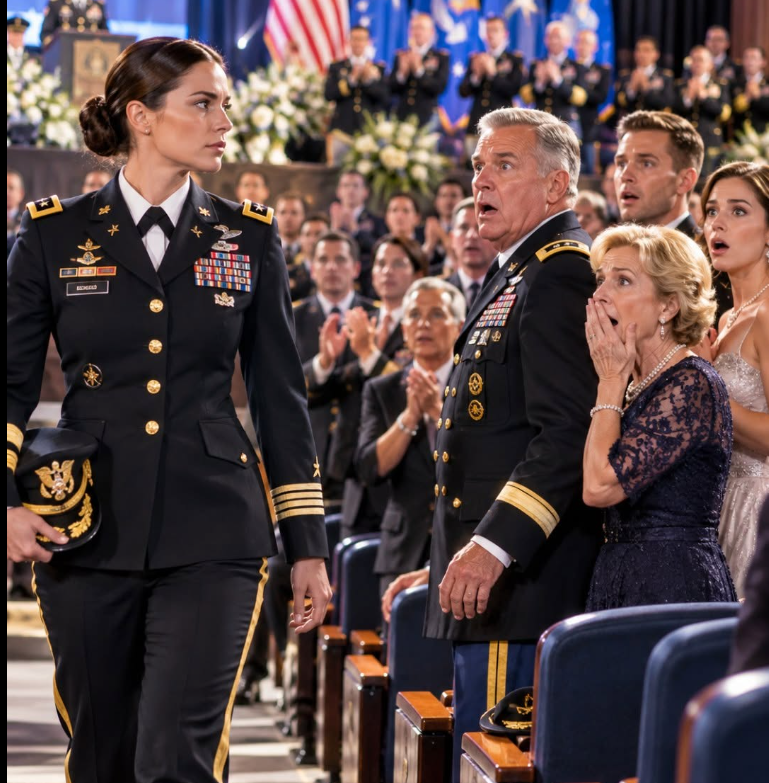
My brother walked to the table in his Army service uniform. He did not look at our father as he passed. He took a small digital recorder from his pocket and laid it on the table.
“This was recorded in my father’s home in Virginia,” he said. “In his study. Virginia is a one-party consent state. I was a party to the conversation.”
Colonel Okoro nodded to the technician.
The recording crackled to life. Penn’s voice, tight with anger: Did you tell Leland to flag my packet? A long pause. Then our father’s voice, tired, impatient, unmistakable.