
Chapter 21
My father had paid back eleven thousand dollars of restitution so far, in small monthly checks. Each one came with a short note. At first they just said Payment enclosed. Lately, they’d started to say more. Saw a little boy in a firefighter costume at the grocery store. Thought of Noah. I kept them in a drawer. I hadn’t answered yet. But I hadn’t thrown them away.
My mother had sent one letter, in August. It said only: The children at the hospital ask for me now. I understand a little better what I threw away. I didn’t know what to do with that. Ruth told me I didn’t have to know yet. Healing isn’t a deadline.
As the sun set over the vineyard and the band started a slow song, someone tapped my shoulder.
Jonah Hayes stood there in a suit that finally fit, holding out his hand. Over the past year and a half, he had become a foundation volunteer, then a friend, then the person I called when the grief came back like weather. Slowly, carefully, without either of us rushing, he had become something more. Ava, now eight, was across the dance floor teaching Tom Miller a dance she’d learned on YouTube. Tom was terrible at it and laughing harder than I’d seen him laugh since the funeral.
“Dance with me?” Jonah asked.
I glanced at Margaret. I always glanced at Margaret. She smiled and nodded, eyes wet. Live, she had told me at the cemetery. That’s your job.
I took his hand.
As we swayed under strings of soft white lights, I touched the silver locket at my collar. Lily’s gap-toothed grin. Noah’s tiny firefighter helmet. Two faces who would never grow older, and whose names would now keep thousands of other children safe.
For a long time, I believed the worst day of my life had taken everything from me. My husband. My children. The family I was born into.
But grief taught me something my parents never did. Love isn’t measured by blood or by what you inherit. It’s measured by who stays when staying costs something. By who drives six hours. By who holds you upright beside three coffins. By who tells the truth when a lie would be easier.
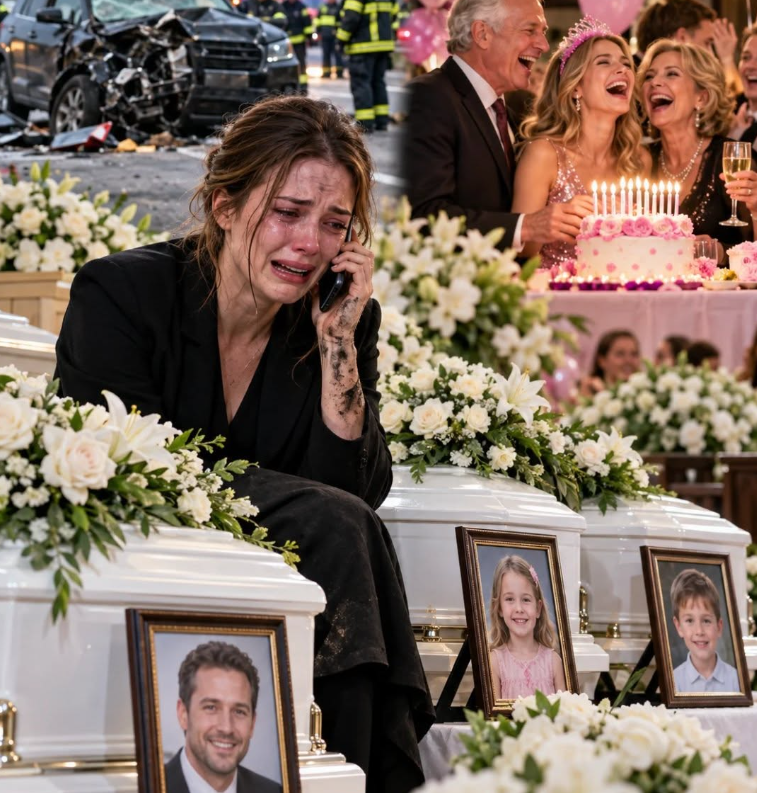
My parents chose a birthday dinner over my children’s funeral.
I chose something different.
I chose to turn my children’s names into a promise. I chose people who showed up. I chose to believe, finally, what my grandmother wrote to me twenty years before I was ready to read it.