
Chapter 2
His jaw grew rigid. “You never were very good at making empty threats, Clarissa.”
“This isn’t a threat,” a deep, authoritative voice rang out from somewhere among the guests.
The crowd parted. Every conversation abruptly stopped. Military officers straightened to attention.
Admiral Marcus Thorne stepped forward—the man whose signature alone determined the fate of billions of dollars in defense contracts.
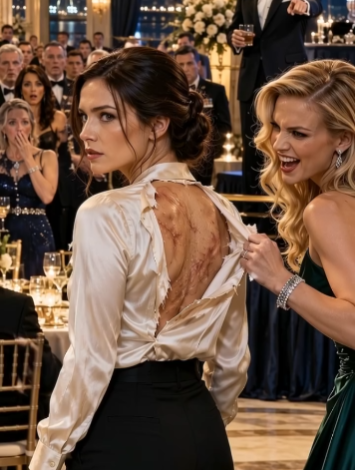
He came to a halt directly before me. As his eyes settled on the scars covering my back, his battle-hardened expression filled with unmistakable emotion.
Then, before my vicious sister, my overbearing father, and every influential guest who had just mocked me, the powerful Admiral brought his heels together, lifted his hand in a perfect military salute, and spoke.
“Captain Vance...”
PART 2
He stopped himself, and a faint, almost apologetic smile touched the corner of his mouth.
“Forgive me. Old habits. Welcome home, Captain Harrington.”
Harrington. My grandmother’s maiden name. The name I had taken legally the week I stopped being a Vance in anything but blood. The name stitched above the pocket of every uniform I had worn for five years.
I returned the salute. My arm didn’t shake. I had saluted in worse conditions than this—soaked, burned, with smoke in my lungs and a dead man’s blood drying on my sleeve. A ballroom full of stares was nothing.
Up on the stage, my father’s hand opened.
The crystal tumbler fell. It hit the marble and exploded into a thousand glittering pieces, bourbon spreading across the floor like a dark stain no one moved to clean. The sound cracked through the room, and two hundred people flinched at once.
Arthur Vance did not flinch. He simply stared at me, and for the first time in my entire life, I saw something in my father’s eyes that I had never seen before.
Fear.
Admiral Thorne unbuttoned his dress jacket, the one heavy with ribbons and decades of service, and settled it over my shoulders. The wool was warm. It smelled faintly of cedar and pipe tobacco, the way it had the morning he pinned the Navy Cross to my hospital gown.
“You didn’t have to do that, sir,” I said quietly.
“Yes, Clarissa,” he answered, just as quietly. “I did.”
Then he turned to face the room.
“For those of you who don’t know who you’re looking at,” he said, and his voice carried to the farthest chandelier, “this is Captain Clarissa Harrington, United States Navy. Five years ago she was the executive officer of the USS Meridian. On the night of March fourteenth, a fire broke out below decks. The suppression system failed. The hatches jammed. Thirty-one sailors were trapped in a corridor that had become an oven.”