
Chapter 1
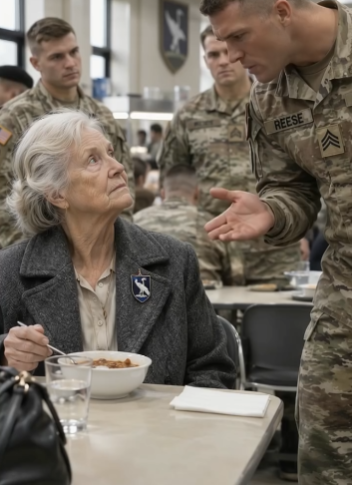
I was eighty-one years old, quietly enjoying a bowl of chili inside an Army dining hall, when a young staff sergeant stopped beside my table.
“Hey, Grandma!” he shouted. “What rank did you hold back when dinosaurs were roaming the earth?”
His two companions burst into laughter.
I continued eating.
But within seconds, the conversations around us began to fade. Nearly two hundred soldiers gradually turned to watch.
The sergeant demanded my identification, questioned why I was on the military installation, and ordered me to stand.
Then his eyes caught the small, weathered brass insignia pinned to my gray coat.
His expression immediately hardened.
“That’s my battalion’s emblem! You have no business wearing it. Take it off!”
I looked at him calmly.
“No, Sergeant.”
He stepped closer, clearly offended by my refusal.
But instead of arguing, I glanced toward an inscription painted above the serving counter.
He had walked beneath those words almost every day for three years.
And if he’d ever bothered to read the smaller dedication underneath, he would have known why that insignia belonged to me.
Part 1: The Thursday lunch
“Ma’am! I’m speaking to you!”
I slowly placed my spoon beside the bowl.
I’d driven forty minutes for this particular chili, and I intended to enjoy it while it was warm.
Three young soldiers stood near my table.
The loudest wore the insignia of a staff sergeant. His name tape read REESE.
He appeared to be in his late twenties, broad-shouldered and confident in a way that suggested he wasn’t accustomed to being questioned.
My name is Quinn Braddock. I’m eighty-one years old, and I live in a little yellow house in Clarksville, Tennessee.
For thirty-one years, I worked as a school nurse, caring for children with everything from scraped knees to serious medical emergencies.
But before I became a nurse, I’d worn a very different uniform.
And the experiences behind that uniform had shaped the rest of my life.
That October afternoon, I was visiting Fort Campbell, Kentucky.
I’d completed the required visitor procedures earlier that morning and received authorization to enter the installation.
After finishing my business, I decided to stop for lunch.
I wore comfortable black shoes, a gray wool coat, and a small brass pin that I’d treasured for more than fifty years.
Most of the soldiers around me were young enough to be my grandchildren.
Until Sergeant Reese approached, nobody had paid much attention to me.
“Are you lost, Grandma?” he asked with a smirk. “This isn’t a retirement community.”
His friends laughed again.
I looked up.
“No, Sergeant. I know exactly where I am.”
He raised his eyebrows.
“Then explain why you’re sitting in a military dining facility.”
“I came for lunch.”
One of his companions chuckled.
Reese didn’t appreciate the answer.
He placed both hands on the neighboring table and leaned toward me.
“Listen carefully. This is an Army installation. You can’t simply wander in whenever you want.”
“Of course not,” I replied. “That’s why I completed the visitor procedures.”
He frowned.
“Then show me your identification.”
My valid visitor pass was inside my handbag.
I could have produced it immediately.
But something about his performance bothered me.
He wasn’t quietly verifying a visitor’s authorization.
He was entertaining his friends by embarrassing an elderly woman in front of a crowded dining hall.
“Are you assigned to visitor verification today, Sergeant?” I asked.
He straightened.
“I’m responsible for maintaining standards.”
“Then that’s an important responsibility.”
His expression tightened.
“Identification. Now.”
At a nearby table, a young female private looked up.
She seemed uncomfortable with the exchange.
For a moment, I thought she might intervene.
Then she noticed Reese’s rank and looked down again.
I understood her hesitation.
Military hierarchy could make challenging a superior intimidating.
But I’d learned long ago that leadership wasn’t measured by how loudly someone gave orders.
Reese grew impatient.
“That’s enough. Stand up.”
I remained seated.
“Why?”
“Because I told you to.”
I regarded him quietly.
His face grew red.
He seemed determined to turn a simple lunch into a contest of authority.
Then something caught his attention.
His gaze shifted toward my coat.
Pinned near the collar was a small brass insignia bearing a blue shield and a white heron with outstretched wings.
The enamel had chipped with age.
The metal had darkened slightly.
But I kept it polished and wore it with pride.
Reese stared.
“Where did you get that?”
I didn’t respond immediately.
He leaned closer.
“That’s my battalion’s emblem.”
“I know.”
His eyes narrowed.
“That symbol represents generations of service. Soldiers have worked hard to earn the right to wear it.”
“Yes,” I answered. “They certainly have.”
“Then you should understand why you can’t just pin it on your coat.”
I rested my hands on the table.
“You’re assuming quite a lot, Sergeant.”
His companions exchanged uneasy glances.
Reese pointed toward the insignia.
“Take it off.”
“No.”
He blinked.
“Excuse me?”
“I said no.”
The dining hall grew noticeably quieter.
Reese straightened his shoulders.
“That emblem doesn’t belong to someone who hasn’t earned it.”
I looked directly into his eyes.
“Be careful about deciding what another person has earned.”
His jaw tightened.
“You’re refusing a direct instruction.”
“I understood what you said.”
He stepped closer.
“Either you remove it yourself, or I’ll have to take further action.”
The young private suddenly rose from her chair.
“Sergeant, perhaps—”
I gently lifted one hand.
She stopped.
Then I turned back toward Reese.
“Young man, how long have you been assigned to this battalion?”
He looked confused.
“Three years.”
“Three years?”
“That’s right.”
“And you’ve been eating here regularly during that time?”
“Obviously.”
I nodded slowly.
“Interesting.”
He folded his arms.
“What’s interesting?”
Instead of answering, I looked past his shoulder.
Above the serving counter, large blue letters stretched across the wall.
Beneath them was a smaller inscription commemorating an important chapter in the battalion’s history.
Every soldier entering that dining hall passed beneath those words.
Some probably read them on their first day.
Others may have walked past them hundreds of times without giving them much thought.
Reese followed my gaze.
“What are you looking at?”
“That inscription.”
He glanced over his shoulder.
“What about it?”
“Would you mind reading it?”
He scoffed.
“I know our battalion motto.”
“I’m sure you do.”
“Then what’s your point?”
“Read the dedication underneath.”
By now, nearly two hundred soldiers were watching us.
Trays sat untouched.
Conversations had stopped.
Even Reese’s companions were no longer smiling.
He glanced toward the wall again.
“What’s this supposed to prove?”
I gave him a small smile.
“Perhaps nothing. But indulge an old woman for a moment.”
He hesitated.
Then slowly turned.
His eyes traveled across the large lettering.
Next, he looked down toward the smaller inscription.
I watched his lips move as he began reading.
And suddenly, I was no longer thinking about the chili growing cold in front of me.
I was remembering a day fifty-six years earlier.
A day when that same brass insignia had been placed in my hand.
I remembered the people who had served beside me.
The difficult choices we’d faced.
The promises we’d made.
And the reason I’d carried that little emblem through every chapter of my life.
Reese continued reading.
Then he stopped.
His shoulders stiffened.
He looked down at the insignia on my coat.
Then back at the wall.
His expression changed so completely that one of his companions leaned forward to see what he’d discovered.
For the first time since approaching my table, the young sergeant seemed uncertain.
I picked up my spoon.
“Keep reading, Sergeant,” I said quietly. “Especially the name at the bottom.”
He looked again.
And as his eyes reached the final line, the color slowly drained from his face.