
Chapter 5
Lieutenant Colonel Andrea Whitfield had commanded the battalion for four months. She was sharp, polite, and visibly exhausted. She had listened to me for twenty minutes, thanked me for my service, and said the sentence I had feared.
“She said, ‘Without documentation, Ma’am, it’s one memory against another.’” I folded my hands. “And she’s right. Gordon Pike has a bestselling memoir, a foundation, and two million dollars. I have a chipped pin and a bad hip.”
“You have that wall,” Reese said.
“Paint is cheap, Sergeant. So is drywall.”
He was quiet for a long moment. Then he said something I don’t think he’d ever said aloud.
“My grandfather got thrown out of the Army.”
Dunmore glanced at him but didn’t interrupt.
“Other than honorable. The report said he left his position at LZ Crane under fire. Abandoned the wounded.” Reese’s voice hardened. “My dad was eight when it happened. He grew up with kids calling his father a coward. He hasn’t spoken to Grandpa in twenty years. Grandpa’s in a VA home up in Indiana, and nobody visits.”
He looked down at his hands.
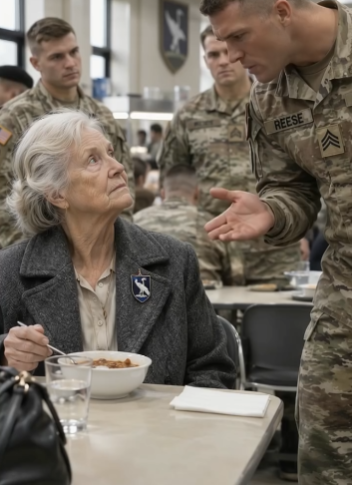
“I joined the Herons on purpose. I asked for this battalion. I thought if I wore this patch long enough and did it right, maybe I could… I don’t know. Clean the name off.” He laughed, but it wasn’t a laugh. “And today I yelled at an old lady in front of two hundred people. Real clean.”
I reached across and put my hand on his arm.
“Sergeant, listen to me very carefully. Your grandfather did not abandon anyone. He was nineteen years old, and when the captain ran, he stayed.”
Reese lifted his head.
“The captain,” Dunmore said slowly.
“Captain Gordon Pike.”
Nobody spoke.
“Ma’am,” Dunmore said finally, “if that’s true, the battalion needs to know before Friday. Is there anything in writing? Anything at all?”
“There was.” My throat tightened. “In 1971, Raymond Reese wrote me a letter. Four pages. He described the whole night. What Pike did. What we did. He signed it and dated it, and he asked me to keep it safe in case anyone ever asked.” I took a breath. “I kept it in a cedar box in my bedroom closet for fifty-five years.”
“Kept,” Reese repeated.
“Three weeks ago, when Colonel Whitfield’s office scheduled my meeting, I went to get it.” I looked out the window at the flags snapping in the October wind. “The box was there. The letter was gone.”