
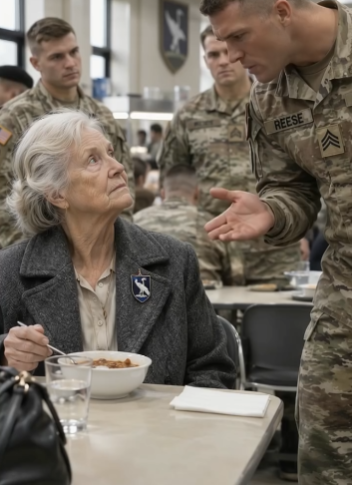
Chapter 4
My heart did something it hasn’t done in a long time.
“Sergeant,” I said quietly, “where is your family from?”
He frowned. “Ma’am?”
“Your people. Where are they from?”
“Hopkinsville, mostly. My grandfather came down from Indiana.” He shifted. “Why?”
“Muncie, Indiana?”
The color he’d just gotten back left him all over again.
“How do you know that?”
“Is your grandfather’s name Raymond?”
Price looked from me to Reese and back again.
Reese’s voice came out barely above a whisper. “Nobody in my family says that name, Ma’am. How do you know it?”
I set my spoon down for the second time that day.
“Because your grandfather is the reason I’m alive,” I said. “And he’s the reason a man named Gordon Pike wants that wall painted over by next Friday.”
Part 3: The Man Who Wanted the Wall Gone
At fifteen hundred, I was sitting in Command Sergeant Major Dunmore’s office. So was Staff Sergeant Reese, who looked like he hadn’t breathed since lunch.
Dunmore had insisted I stay. “You started something in my dining hall, Ma’am,” he said. “I’d like to know how it ends.”
So I told them why I had come to Fort Campbell that morning.
The Herons’ dining facility was old. Everyone agreed it needed renovating. Six months earlier, the Pike Foundation had offered two million dollars to rebuild it from the floor up. New kitchen. New furniture. A fitness corner and a coffee bar.
There was one condition.
The building would be renamed the Colonel Gordon R. Pike Dining Facility. And the old painted dedication would be replaced with a bronze plaque describing Colonel Pike’s “heroic leadership” at Landing Zone Crane.
“I read the draft plaque,” I said. “It doesn’t mention the nurse. It doesn’t mention the wounded he left behind. It says he organized the defense of the landing zone through the night.”
Dunmore’s eyebrows went up. “He wasn’t there through the night?”
“He was on the last helicopter out,” I said. “In a seat meant for a wounded man.”
The office went very still.
Reese stared at me. “Ma’am, Colonel Pike is—” He stopped. “He spoke at my promotion ceremony. He signed my copy of his book. The Last Light at Crane. It’s on my shelf right now.”
“I’m sure it’s very well written,” I said. “Gordon always could write a report.”
Dunmore rubbed his face. “Ma’am, you met with Lieutenant Colonel Whitfield this morning. What did she say?”