
Chapter 9
Protect the company, he'd said. But don't expose your unit.
So I did the only thing I could think of that honored both halves of that promise.
Two days after his funeral, I drove to the FBI field office in Richmond and asked for an appointment. I sat in a gray room across from a young agent named Marcus Webb, and I gave him everything my father had given me: account numbers he'd scrawled on the back of a hospital menu, the names of three companies I'd never heard of, and a single sentence from a dying man.
Webb listened. He asked good questions. And then he asked me for something hard.
"We need time," he said. "If this is what it looks like, whoever's behind it will panic the second they know we're looking. They'll move the money, destroy the records, and we'll never get it back. Can you keep quiet? Even if things get ugly?"
I almost laughed. "Agent Webb, keeping quiet is the one thing I'm really, really good at."
I didn't know then how ugly it would get. Three days later, Caleb produced the new will.
It left him everything. The controlling shares. The house on the river. My father's seat on the board. It was dated eleven days before Dad died, witnessed by two people I'd never met, and notarized by a man named Anthony Grell.
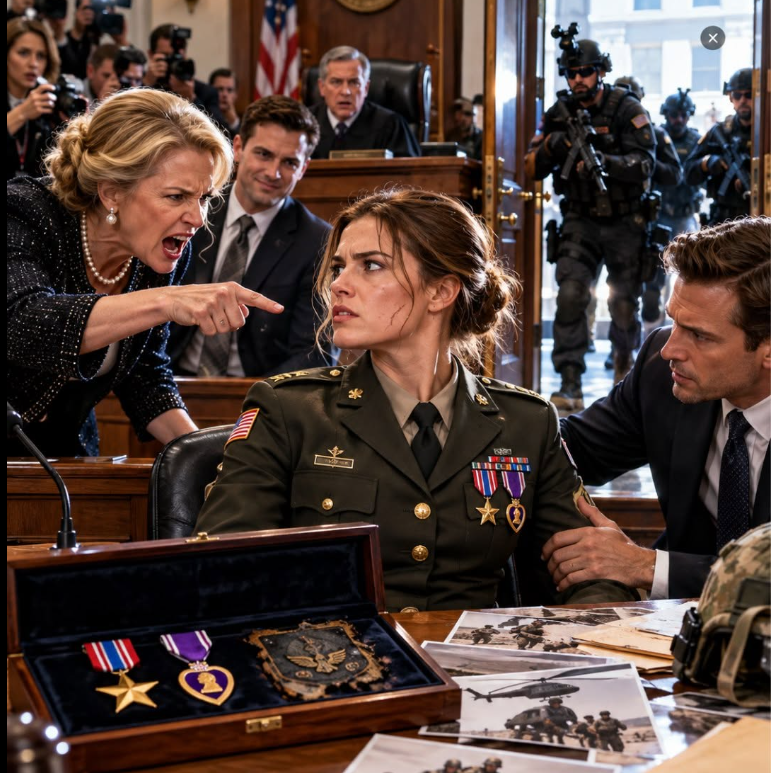
When I challenged it, Caleb didn't just fight back. He went to war. He dug through Dad's home office and found the safe where Dad kept the only things I'd ever let him keep for me: my medals, my patch, a photograph of me in uniform with my team, faces carefully cut out. He took them to a lawyer. The lawyer submitted a records request to the Army's National Personnel Records Center.
And the Army wrote back, truthfully, that it had no releasable record of any soldier named Mara Elizabeth Bennett.
Of course it didn't. That was the whole point of a sealed record.
But Caleb took that letter and built a case on it. He brought it to a prosecutor's office already buried under stolen-valor complaints. He brought it to the newspapers. And he brought it to our mother.
What Agent Webb learned over the fourteen months that followed, while I sat silent and let the world call me a liar, was this: Anthony Grell, the notary on Caleb's new will, was listed as the registered agent for all three of the shell companies my father had written down. Over four years, those companies had billed Bennett Meridian for more than nineteen million dollars in consulting services that never happened. And every single dollar had eventually landed in accounts controlled by my brother.