
Chapter 2
The prosecutor, Assistant U.S. Attorney David Kessler, was already on his feet. He was a careful man in a navy suit who had treated me for eleven days with the chilly politeness people save for someone they're sure is lying. "Your Honor, the government has received no notice of any witnesses from the Department of the Army. This is highly irregular."
"It is," Alvarez agreed calmly. "And in about twelve minutes, Your Honor, I believe you'll understand why."
On the witness stand, my mother had gone pale. Linda Bennett had worn her good navy dress for her testimony, the one she wore to church and funerals. Her hands were folded in her lap, but I could see her knuckles.
Across the aisle, Caleb had stopped studying the floor.
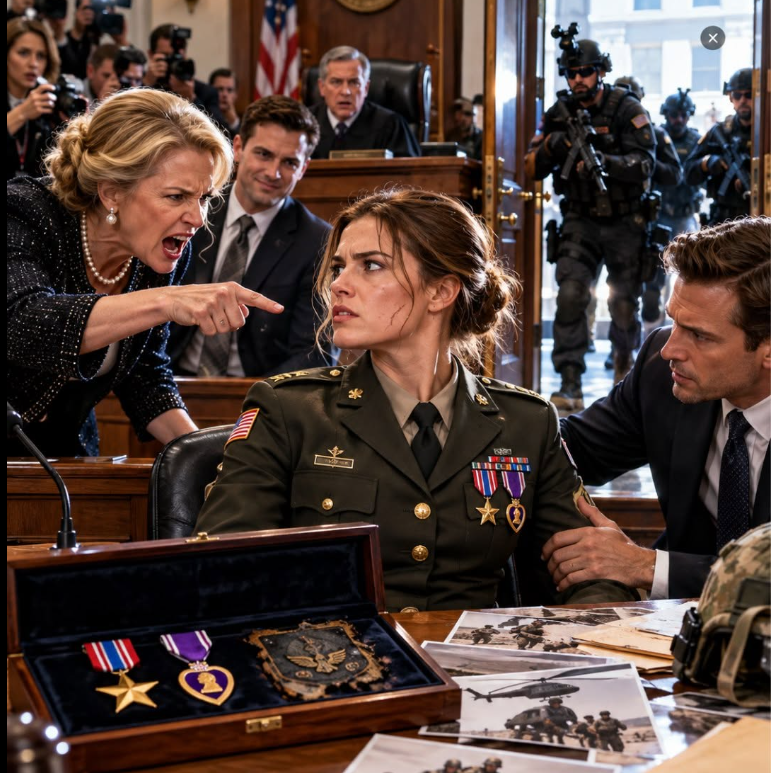
Judge Marsh looked at the clock on the back wall. Then she looked at me. I had the strange sense that she was seeing me for the first time, not as the defendant, but as a person sitting very straight in a chair, waiting.
"Counsel," she said. "Approach. Colonel Alvarez, you too."
I couldn't hear what they said at the bench. Nobody could. The court's white-noise machine hissed over their whispers, and all the rest of us could do was watch.
Kessler was shaking his head. Caleb's private attorney, a man named Brent Lowell, who had been sitting in the gallery all trial like a coach at a game he wasn't allowed to play, had moved up to the rail and was leaning forward as if he could hear through sheer effort. Alvarez opened her leather portfolio and laid a single document on the bench. The judge read it. Then she read it again.
I looked at my hands.
There is a skill you learn in certain kinds of work, and nobody teaches it to you in a classroom. You learn to be still while everything around you is loud. You learn that your heartbeat is a thing you can hold, like a breath. I had learned it on a mountainside a long way from home. I had used it every day of this trial. And now, with thirteen years of silence finally about to end, I used it harder than I ever had.
Because I knew exactly what I was waiting for.
Fourteen months ago, the night after my father's funeral, I had sat alone in my car in the parking lot of a Waffle House outside Richmond and written a formal request to the Department of the Army. Not to break my oath. Never that. I asked, through proper channels, for a declassification review of my service record, only the parts needed to prove that I existed. That I had served. That I had earned what I'd been awarded.